Ο Marcus Aurelius, Roman Emperor (161-180 AD), in his book "The things in oneself" (In Greek: "Towards Himself", also known as "Themselves"), does not want to "tell us" anything conventional. It is not a book written for the public. It is the his personal diary, written in Greek during military campaigns on the border of the Empire.
His purpose was not to teach, but to reminds himself the principles by which he was to live and govern. Therefore, what he "tells us" is in essence the internal his monologue, a series of reminders and exercises to remain calm, just, and virtuous amidst the chaos of life and power.
The core message that emerges from the study of his book can be summarized in a few basic, interconnected ideas: Stoic Philosophy:
- Controlling Expectations & Reaction
The most central message. Mark constantly repeats: We do not control the events that happen to us, but only our reaction to them.
"If you are in pain from something external, it is not what is bothering you, but your judgment of it. And it is up to you to cancel that judgment."
- Perishability
Everything in the world is temporary and transitory. The glories, the pleasures, the riches, even our life and our memory after death. Accepting this fact alleviates fear and greed.
"Life is a cloud, death a transition. Everything is small, transient, frivolous."
- Common Humanity & Social Duty
All people are members of the same "body", the humanity. As rational beings, we have a duty to cooperate and help each other, even when they challenge us.
"I was born to collaborate. To benefit my fellow human beings. This is my purpose."
- Acceptance of Fate
Let us not defy or complain about our fate, but embrace it. we accept and to see obstacles as opportunities to practice virtue.
"Whatever happens, happens rightly. If you observe carefully, you will find that it is right."
- Attention to the Present
To live in presentLet us not dwell too much on the past that does not change, nor on the future that we do not know.
"Do not limit yourself to the future or the past, but limit yourself only to the present."
- Inner Calm (Ataraxis)
The ultimate goal is the peaceful and calm soul, regardless of external circumstances. This is the true "kingdom" of man.
"A pure soul is one that is freed from passionate impulses."
- Law as a Basis
Η justice It is a fundamental virtue. In every action and decision, man must ask: "Is it fair? Is it for the common good?"
What Does This Mean for Us Today?
Marcus Aurelius does not offer easy answers or positive slogans. Instead, he invites us to:
Let's take responsibility. about our thoughts and reactions.
We accept uncertainty. and death as part of nature.
Focus on shaping our character rather than in the acquisition of external goods.
We view people with compassion and understanding, remembering that they too are struggling.
We find meaning not in success, but in self-realization and in service to others.
It is a book that not read, but studiedEvery time one opens it, one finds a new, profound truth that helps one face one's own challenges with greater wisdom, calm, and courage.
Brief biography of Emperor and philosopher Marcus Aurelius
Marcus Aurelius Antoninus (26 April 121 – 17 March 180 AD) was Roman Emperor from 161 until his death and the last of the so-called "Five Good Emperors".
Born into a noble family, he was destined for power from an early age and was adopted by the then Emperor Antoninus Pius. He ascended the throne in 161 AD and ruled for almost two decades, which were marked by constant wars against Germanic tribes on the northern borders and a devastating plague.
Despite the difficulties, he went down in history as the "Philosopher on the Throne". He was faithful to Stoicism and its values. His personal diaries, known as "To Himself" (To Himself), remain one of the most important works of philosophy, where he examines issues of morality, justice, and logic.
He died in 180 AD in Vienna (Vindobona), during a military campaign, leaving behind the reputation of a just, wise and virtuous leader.
Source:
Marcus Aurelius "The Things to Himself". AMNON Publishing. Athens 2020.
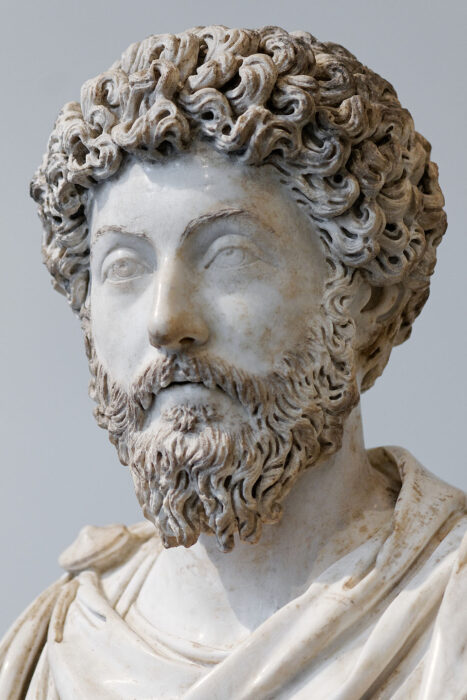
photo
Photo By Marie-Lan Nguyen (2011), CC BY 2.5, https://commons.wikimedia.org/w/index.php?curid=12915724 https://el.wikipedia.org/wiki/