But I lived.
And I did not live in vain!
George Gordon Byron
They say that great writing is created in a course full of bruises between the Word and the Language. That is, between the official ideological code of every society and the personal anguish of every creator.
They also say that Art is not a search or a mirror of real life, but on the contrary, the most complex denial of the ultimate truth. The truth of our death. A -constantly surprised with itself- belief in our bodily immortality, which makes Art the absolute "Oedipal product". Made a "poem" that tries to surpass the Father - God by solving the "enigma" of the Tree of Knowledge (and therefore of Creativity) that every symbol of power, wants for its exclusive possession, offering as redemption the peace and wealth of a (absolute by definition) paradise.
Finally, they say that here begins the human adventure of an awkward, contradictory, often vulgar, constantly fascinating, but more dignified than the residence of the "plant in the Garden", independence. Adventure hidden, but not forgotten, behind dozens of names (Paradise or Jerusalem, Ithaca or Socialism, Personal Happiness or Philosophical Fulfillment) and the efforts to find them that have tormented man since the time of Moses and Odysseus…
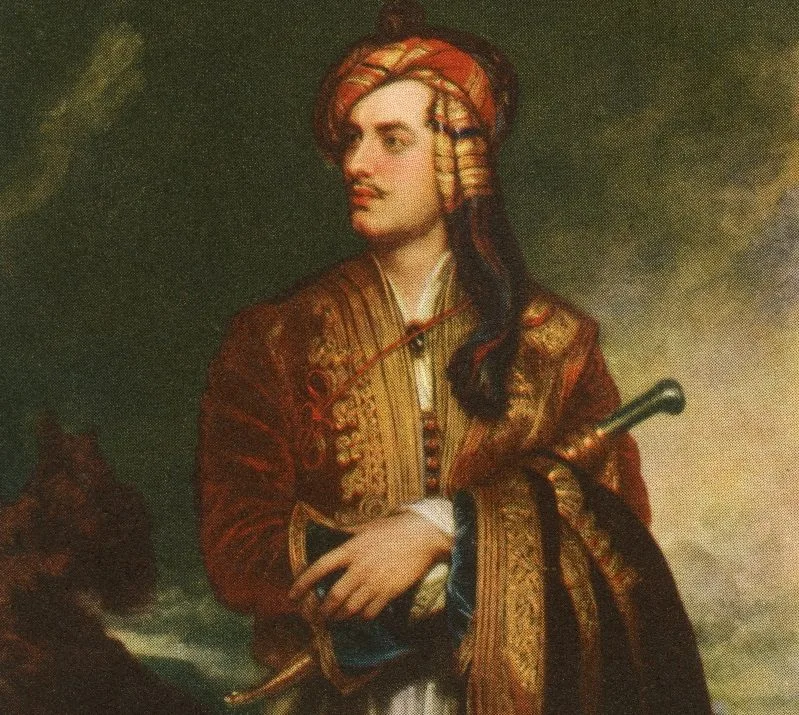
Each and every one of us experiences this adventure in our own way. Others privately, choosing to live in their own microcosm. Others in public, choosing or using public to agra of various rewards for any kind of career, and others to intervene towards a more holistic vision, choosing to burn from their own fire. Such was the case with Lord Byron, and that is why our schools imposed on us a case-by-case and limited ethnocentric view of him.
Why, in fact, is it worth asking again what might be the significance of remembering a poet in our "wild age", years after the heartbreaking question "And what do poets need in a small-minded world"? An era in which while individual fascisms and barbarities seem capable of hiding, they also seem capable of "winning" on new scales?
Because while in our childhood a simple "surrender" was enough to stop the fight, since the goal was victory and not the humiliation of the opponent, (something very similar to what usually happened in Greek antiquity but also in "primitive" cultures such as of the Aborigines that even in the case of the animal you killed for food it was forbidden to behead even the prey…) now the goal is not just victory but humiliation. Torture where land (zero Greece excluded), Nazi death camps and the Stalinist Gulag in the civilized 20th century, the barren children of Palestine, or the bombs against innocents in America (incidents of varying degrees but common) do not come from nowhere. And the bad thing is that we get used, not only to what far we can happily complain, but also to ours that we conveniently choose to forget.
For people like Byron (as well as for Solomos) all this was not unrelated to poetry. The reality was these, problems that awaken the consciousness and the dimension of the Divine within us, the cause of poetry, reminding that life course of those who choose to analyze the long journey and the waves, which we pointed out in the opening speech. Reminding with their triumphant defeats the constant struggle of man to reach the rock in the mountain, or hanging on the same rock, to carve unarmed but with the invincible Mind, with his nails the Light.
Byron writes a shocking account of this Promethean and Sisyphean unity of human existence that fascinates him (translated by M. V. Raizis): "What is the reward of your compassion?" Heavy misery and silence / The rock, the vulture, the shackles / Pain of pride that breaks out… Titan! For you the hard struggle / Of the Will and the afflictions / Source of Death or passions / And the heavenly parliament the terrible / And the fate of the slave the deaf / Of hatred the main principle / Who for her fun gives birth / Whatever she wants to spoil … » After all, "war (the secret of peace or the obvious of conflict)" is a loss of souls and humiliation of beings, "said the poet citizen of Byron.
The value of Byron today, that is, his constant topicality, is that he was not just a multifaceted form of Life itself with its capital cap (complex poet, diverse lover, avid traveler and explorer, daring warrior, deep moralist with moral and immoral for the ruling hedonists at the same time) but that he did not for a moment cede citizenship. The quality of the person who can not forget the cries of the person who fights and chooses to become his voice. He ostentatiously expresses his disapproval of the lazy class of the English aristocracy, raises his glove on Victorianism, throws it to lift it on his legendary expeditions to various parts of Europe, takes off his hat to the Indians, denouncing their occupation by the British chooses to side with the enslaved Greeks not only against another empire, but also against his compatriots for Elginia. And he is one of those who come and stay, since he does not love folklorically any slaves like other of his colleagues who left when they knew the "real image" of the Greeks, but he loves them just as their slavery, their needs and their mistakes became.
In fact, Byron is a burning (to remember Sinopoulos) citizen of the world, who lived internationally before the term was even invented. And his ethics, as well as his interests and priorities know no bounds. His own ways, beyond his poetry, become a demonstrative protest against any totalitarianism and its "ethics". After all, if there is one thing we can conclude from the "death camps," wrote Dwight McDonald, it is that those who enforce the law may be more dangerous than those who break it… And he chooses people not his homeland based on the race (and that is why he is deeply anti-racist) but based on the need or the possibility, since he is enchanted by both. "The old ambition breathes renewed, again to animate flesh then fallen"… Myriad breasts unite one and a common cause / Westerners and Orientals revolt by force./On the peaks of Mount Athos and in the Andes waving / banner that is the same as two worlds greets / Athenian again belts Armodiou the sword / A foreign master is denounced by the guerrilla in Chile… "" A desire that many centuries have not yet submitted / people for their lives to decide alone! "
And Byron's Greece? Country vision and pain. A symbol for a world that, far from the classical ideals of democracy and critical thinking, has been betrayed and is declining, but at the same time for another world that, even if it is not possible, is necessary. "Hellas! Nice! A sad relic of value that has fallen! Non-existent, but immortal. Trani but fallen! / In front of your scattered children who wants to lead, / and from the habit of slavery to get rid of you? "Such were not your old sons who gathered, / without hope fighters how willingly they accepted / In Thermopylae, in the Straits, to fall dead?
And yet, it can and does prophesy at the same time a tragic fate of centuries, when the protective forces of the time (replaced in our time by others, in the complex geopolitical game of the Balkans, replaced one occupation with another. Common fate of peoples and places , which only with the self-action of the citizens, of the philosophically inclined people towards the action, that is, who choose the dignity of the struggle, even if they are crumpled, could be overthrown. "Hereditary binders! You do not know how to / Those who ask for money themselves to hit? / Should not victory be achieved with their weapons? Will the French or Russians come to rehabilitate you? / Your masters may indeed be trampled on / But for you the altar of leprosy will not be lit / Shadows of the Helots now let them defeat your enemy! .
Byron feels the latter and uses his lyrics systematically, to describe that violence is the other face of hypocrisy and corruption but also of resistance against it. He resists in his own way and with his unconventional choices and writings in each hierarchy. He plots against everyone, including himself. Voluptuous but also martyr, denouncing the "unformed and omnipotent violence, moral and material, exercised by a vengeful, corrupt and hypocritical society against those who refuse to assimilate with it" (Taubritz, for Williams). The symbolism of his death was enormous, and the echo of the "Guevara poet" still resounds if we listen carefully to the soil in which he acted. "Man is born of his own desolation!" writes in Manfred, reconnecting with a Greek tradition… The one who wants, according to the Platonic definition, Democracy to be the state in which every question is a personal question. The state where every question has to be answered in your emptiness, when you are alone in front of your mirror of consciousness
This is exactly the realization that Thomas Mann made, trying to explain the kind of man who, when Nazism prevailed, cried when he heard Bach but laughed when he killed children, to talk about the delusion of German bourgeoisie. For the delusion of those who thought that their standard of living (like the one we suddenly acquired in European Greece κι) and culture are enough to make people human. They are not enough without political conscience, he stressed. They are not enough without the conscience of the citizen. That is, the man who does not turn a blind eye to the disappearances of his neighbor, who does not close his ears to the cries of the "Other". Since he considers that every question that reality asks him is a personal question. Something that concerns him when he looks alone in the mirror. That is, when he has to be born only from his conscience in his own emptiness…
"Obstacles came to you from above / but your action and endurance / Of the invincible Mind / That Earth and Heaven defy / An example became everywhere / Symbol and sign you / Fate and power of all on Earth / Half god, like you? , A cloudy stream from a pure source / Man can somehow see / His tragic fate, / The crap and the Endurance? A monk's existence of sorrow / Let the mind resist / Only let it be measured / With will and deep meaning / which from its passions expects / its reward only now / Triumph of courage that defies / and that with Thani wins! " (translated by Marios Vyron Raizis)
Byron won with the mortal because he lived knowing that he had the choice to roam the world loose, or to use his voice to become the voice of the persecuted of his time. And that is exactly what he chose. "But I lived. And I did not live in vain. Maybe the power is lost from my mind, the fire from my blood… and mighty pain can overwhelm my nature. But something inside me will overcome martyrdom and time… and will breathe even after my death… ".
ΥΓ With the signatures of MPs from all parties and on the initiative of the Byron Association //www.byron-greece.org/, April 19 was established as the Day of Philhellenism and Culture. In the person of Lord Byron, the other Philhellenes must be honored, especially the unjust victims of the battle of Peta. The severely wounded general Norman told Mavrokordatos, who was looking to conspire against Ypsilantis, "prince, we lost everything, except the honor".
* Eleni Karasavvidou is a member of the Byron Association for Hellenism and Culture
photo https://greekreporter.com