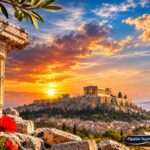
Ancient Greek civilization contributed much to Western civilization. Some of its gifts include democracy, philosophy, art and architecture, mathematics, chemistry, medicine, science, and technology. Analyzing even a few of these achievements would take a long time.
In his book “Demetrios Is Now Jimmy,” Dr. Lazar Odzak presents the experiences of Greek immigrants in the southern states of the United States in the early 20th century. It is an important, well-documented historical record of their adaptation to American society and their contributions.
Greek immigrants also laid the foundations for their presence in the new hemisphere, America. The Greeks exerted a significant influence on the American continent from 1453 to 1938. Paul Koke's book, "A History of the Greeks in the Americas" explains this process.
According to official records, the Greek sailor Don Theodore, who traveled to America in 1528 with the Spanish explorer Panfilo de Narvaez, was the first Greek to land there. Other Greek sailors who arrived in America during the same period were John Griego and Peter the Cretan. In addition, Juan de Fuca, known in Greek as Ioannis Phokas, discovered the strait south of Vancouver Island, which was named after him.
One of the first Greek colonies was established in New Smyrna, near St. Augustine, Florida. Dr. Andrew Turnball and his wife, Maria Roumbini, the daughter of a wealthy Greek merchant, persuaded about 450 colonists to sail and settle in America. Greek settlers from Mani began arriving in Florida on June 26, 1768. The colony failed completely and was officially dissolved. On July 17, 1777, many colonists moved to the neighboring city of St. Augustine, where they became successful merchants and small business owners. This small Greek community established a chapel dedicated to St. Photius and a school in St. Augustine, Florida. The site is now a historic pilgrimage site.
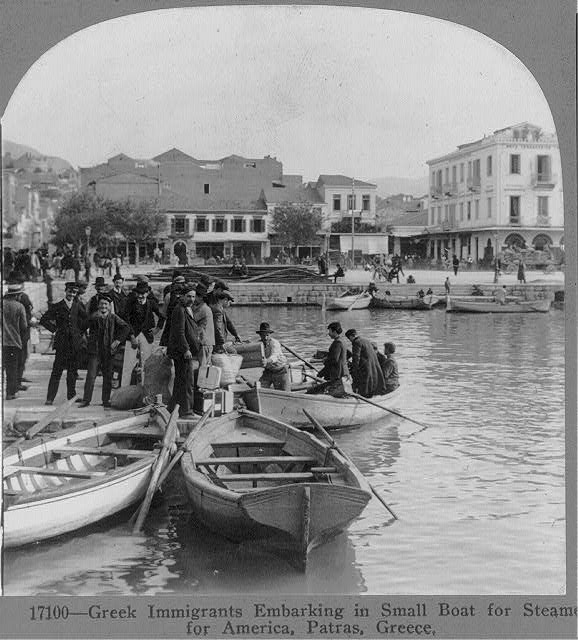
The Greek population in the United States remained small until the 1880s, when deteriorating economic conditions in Greece prompted many Greeks to emigrate. Most were young, single men, seeking better fortunes and hoping to return to Greece as soon as possible. About 30% of those who arrived before 1930 returned. Some returned to fight in the Balkan Wars of 1912–1913.
During the 1890s, Greeks settled in large urban centers, including industrial cities in the northeastern and midwestern states. The first immigrants arrived in Massachusetts and southern New Hampshire. The city of Lowell, Massachusetts attracted the most Greeks and, by 1920, had the third largest Greek community in the United States.
The largest Greek community of the 20th century was in New York City. Greeks also settled in western Pennsylvania, particularly Pittsburgh, as well as in Midwestern cities such as Detroit, Milwaukee, Cleveland, Youngstown, and Chicago.
Small Greek communities existed in Galveston, Texas, and Atlanta, Georgia. However, the largest concentration of Greeks in the South was in Tarpon Springs, Florida. During the first half of the 20th century, this distinct Greek community made its living from sponge fishing.
In the 1920s, Greeks owned thousands of pastry shops across the country, often making their own products. When these businesses failed, many turned to catering. By the late 1920s, several thousand Greek restaurants had opened across the country. Many immigrants in the 1950s and 1960s started out as restaurant workers and later went on to own successful businesses of their own.
The presence of Greeks in the scientific professions remained limited until the 1940s. During the first quarter of the 20th century, most Greek scientists were doctors. They were followed by lawyers, dentists, pharmacists, chemists, professors, politicians and capable businessmen. Several distinguished themselves for their academic achievements and international contribution. A typical example is Georgios Papanikolaou, with the discovery of the test for the early detection of cervical cancer.
When Konstantinos Vournakis left his hometown of Sparta in 1895, he could not have imagined that he would become the first Greek immigrant to arrive in Raleigh, North Carolina. Like many of his compatriots, he pursued the American dream, which attracted immigrants from all over Europe. Greeks were among the first to cross the Atlantic, first encountering the Statue of Liberty and Ellis Island, the usual entry point and checkpoint for new immigrants. They brought different skills and knowledge to the New World, aiming to secure a living.
We do not know what brought Mr. Vournakis to Raleigh. Why did he choose a small Southern town of just 13.000 people? Records show that he owned the California Fruit Stand, on the first block of Fayetteville Street, near the state Capitol. He was soon followed by many other immigrants, along with relatives and friends from Chicago and New York. They moved to Raleigh because they preferred the milder climate, which was familiar to them from Greece.
These early settlers were active in their local community, but they could not find a church to worship God according to their faith. Most arrived without the specialized skills we take for granted today, largely due to limited educational opportunities in their homeland. Their work was typically manual. They turned to restaurants, pastry shops, grocery stores, and cleaning businesses.
By 1924, the Greek families of Raleigh decided it was time to start their own church. The first service was held in April 1924, in the upper floor of a grocery store, on the 100 block of Salisbury Street, where the First Presbyterian Church now stands. The Greek community met on Salisbury Street for four years before moving to a hall in the upper floor of a small grocery store on South Blount Street. As the community grew, it became clear that a larger church was needed.
In October 1935, Father Elias Skipitary was called by the Greek Archdiocese of New York to organize and establish a new church. By 1937, when the church on Person Street was built, Raleigh's population had reached 25.000 and the church served 25 families.
In May 1975, a new church was built on Lead Mine Street in Raleigh to meet the needs of the growing number of Orthodox parishioners. Today, more than 400 families support the Holy Trinity Greek Orthodox Church of Raleigh. However, the current facilities face significant space constraints. The community is planning to build a larger church on the same site, with the hope of completing it within the next two years.
For many, the Greek Orthodox Church is the heart of the community. In the United States, all dioceses, parishes, and churches fall under the ecclesiastical jurisdiction of the Archdiocese of North and South America, an autonomous, self-governing church within the sphere of influence of the Ecumenical Patriarch of Constantinople and New Rome. The Ecumenical Patriarch may elect the archbishop and bishops, directs ecclesiastical affairs outside the American church, and remains the guiding force in all matters of faith. The Archdiocese was founded in 1922 and is headquartered in New York City.
Greece has a rich culture, with customs and rituals passed down from generation to generation. Close family ties, faith and church have always been essential elements of life. As a result, many family traditions and religious celebrations continue to thrive.
Raising children properly is a difficult task. Parents, grandparents, and other relatives actively participate in their upbringing. At the same time, parents emphasize the importance of education and the Greek Orthodox faith. Greek Americans quickly adapted to American customs and learned English. They progressed as American citizens, respecting the United States Constitution.
Family is a primary source of support and identity, and marriage is often seen as a natural step in adulthood. Arranged marriages, in which parents negotiated the choice of spouse, dowry, and inheritance for their children, were once common but have declined significantly.
Greek weddings are particularly rich in rituals and are celebrated with great pomp. Those of you who have seen the movie “My Big Fat Greek Wedding” were probably amused by the complexity of these traditions. If you have seen the movie, please do not believe that Windex cures diseases!
The father of the bride in the film, played by Mr. Michael Constantine, distorts every English word to sound Greek. In his defense, I can confirm that thousands of Greek words are part of the English vocabulary and that many scientific terms from medicine and other fields are added to the English language every day.
Greeks love debate. You’ve seen it in coffee shops, at family dinner tables, and in front of the television: the discussions are loud and intense. But the goal is not to argue, but to seek the truth. Socrates believed that truth emerges through questions, not agreement. Plato wrote dialogues, not textbooks. Aristotle developed logic as a system of organized disagreement. You examine an idea by testing it. Debate wasn’t rude; it was a method.
In Greek culture, silence is not always a sign of respect; active participation in the discussion is. Greeks do not argue to destroy, but to improve, and have been doing so for centuries.
Therefore, if you find yourself faced with an intense Greek conversation, consider it friendly and constructive.
Greeks embody the American dream, hard work and the desire for success. They are considered to be hardworking and devoted to family. They are also said to possess the spirit of "Zorba" and a great love for life.
They like to celebrate with feasts and dancing, breaking dishes and throwing dollars on the dance floor as a sign of appreciation for their friends, honoring their freedom and expressing their joy or sadness. Greek music and dance reflect their national character and are loved by people of all origins.
Greek dances and traditional costumes impress with their originality and historical significance. Greek songs include a variety of unique rhythms, which reveal their origins. Greece has many talented songwriters, who express their views on life, love, happiness, difficulties and family. If you are looking for beautiful music, listen to works by Mikis Theodorakis, the famous composer Yanni, and many other distinguished composers.
For Greeks, the sounds and rhythms of music express their very soul. They bring to life places full of nostalgia and deep feelings of love, dreams, sorrows and joys. The themes of the songs touch on divorce, motherhood, poverty and many human passions, revealing hidden emotions. Add to all this dancing and a little ouzo, and you will find a temporary relief from any sadness.
The national drink of Greece is ouzo, with its distinctive licorice-like flavor. It remains popular among Greeks in America.
Traditionally, it is accompanied by various small dishes, called mezedes. A well-known Greek wine, retsina, also pairs beautifully with mezedes. Retsina is produced exclusively in Greece.
Greeks have a variety of traditional customs, beliefs, and superstitions, which aim to bring good luck and attribute misfortune to evil influences. These old beliefs still survive in some communities in the United States. For example, the belief in the “evil eye” remains strong. For protection, many make the sign of the cross when they suspect that someone or something may be under the evil eye.
Greeks also "beat wood" to ward off bad luck, while kafemancy remains popular.
The Greeks "have a proverb for everything":
"In wine, truth" — when you get drunk, you tell the truth.
"You're making my liver swell" — you make me resentful.
"The old hen has the juice" — quality improves with age.
"I tell my dog and the dog wags his tail" — nothing happens.
"Don't let the wolf guard the sheep" — make sure you understand the situation and who you're trusting with.
"Beans fill the sack" — be prudent and thrifty.
"When the hen drinks water, she raises her head and looks at God" — doing the right thing.
"You ate the donkey and left the tail" — you did almost all the work, but you didn't finish it.
There are many more meaningful expressions, characteristic of the Greeks.
Greek cuisine is particularly popular in the United States, where Greek-American restaurants are thriving. For Greeks, meals are important social occasions, bringing friends and family together to celebrate. Many American-born people, as well as people of various nationalities, visit Greek festivals across the country and look forward to enjoying authentic Greek food, music, and dance.
We invite you to the Greek Festival of the Greek Orthodox Church of the Holy Trinity of Raleigh, as well as to the other charitable events organized throughout the year. You will enjoy authentic Greek cuisine and delicious homemade sweets. You will watch Greek dances under the artistic direction of Dr. Andreas Seas. The dancers wear traditional costumes. Dance with them and shout “oopa” to the Greek rhythms!
Additionally, you will be happy to know that part of the money you spend will be donated to Habitat for Humanity and many other charitable organizations. Greeks are known for their generosity and steadfast support for charitable causes.
Greek traditional costumes come in a wide variety of designs and colors, some dating back to antiquity. Women's costumes are heavy, with many layers and accessories designed to cover the entire body. Each region has its own unique colors and patterns. Traditionally, men's costumes are less colorful than women's.
The Greek language has largely retained its original character over the years. During the Byzantine period, it exhibited dialectal variations in many regions. Modern Greek still uses the ancient alphabet and some of its original grammatical features.
Today, Greek schools continue to encourage learning the language, while new generations are discovering its many benefits.
If there is one concept that particularly characterizes the Greeks, it is philotimo, which can be translated as “love of honor.” Philotimo is a deeply rooted sense of right and wrong, which includes personal dignity, honor, and duty to family and community. It influences and determines the way people relate within the family and society. Philotimo is what “laid the foundation for the success of the Greeks in America.”
The importance of family and the bond with the Greek Orthodox Church remain strong among Greek Americans. In many communities, the man is considered the head of the ideal family. As husband and father, he is the central authority and decision maker. Children are of special value, and parents often make great sacrifices to help them achieve their goals.
Wedding, baptism and funeral services, when performed by a Greek Orthodox priest, can be held in both Greek and English. However, the traditional elements of these services remain the same and always follow the sacred texts of the Greek Orthodox Church.
Since the first Greek immigrants arrived in the United States, Greek-American women have had limited opportunities to have their voices heard. Traditionally, their lives revolved around home, family, and the Greek Orthodox Church.
These women played a crucial role in preserving Greek culture and traditions from the early years of Greek settlement in the United States. Women of the first and second generation of immigrants became the custodians of songs, dances, and other folk customs.
Today, many Greek women face difficult choices as they try to combine the values of two different worlds. The pressure to maintain their ties to the community, follow their parents' rules, and be "good girls" who will have a "good marriage" and have children remains strong.
The conflict lies between devotion to family and personal fulfillment, between duty to parents and community and the desire for the “American way of life.” Many Greek-American women have less freedom than men and often remain closely tied to their mothers even after marriage. However, this perception is beginning to change among the new generation of Greek women.
Most Greeks prioritize higher education. The 1990 census shows that Greek Americans are among the groups with the highest rates of college degree attainment in the United States, with many continuing on to master's and doctoral studies.
Many Greek-American political and social organizations have existed since the 1880s. These groups were usually composed of Greeks who came from the same region of Greece. They were united by a strong sense of Hellenism, a common religion and language, and generally supported the interests of their homeland.
In 1907, the Panhellenic Union was founded, with the aim of coordinating local groups and providing financial support to Greece. It also helped Greeks adjust to their new lives in the United States. Gradually, many Greek immigrants accepted that they would not return to Greece and that the United States was now their permanent homeland.
In 1922, the American-Hellenic Educational Progressive Association, known as AHEPA, was founded. AHEPA supported the adjustment of Greeks to American life and their education. It also contributed significantly to the work of the Hellenic War Welfare Association during World War II.
The main issue that politically mobilized the Greek-American community was the Turkish invasion of Cyprus on July 15, 1974. The efforts of well-organized political influence groups to impose an arms embargo on Turkey were impressive.
AHEPA played a leading role in these efforts, along with other organizations such as the American Hellenic Institute and its Public Affairs Committee, the powerful United Hellenic American Congress, and the Hellenic Council of America. The Greek Orthodox Church and local community organizations also offered their assistance. Largely due to the effective political action of these groups, the United States imposed an arms embargo on Turkey on February 5, 1975.
Greek Americans have made significant and commendable contributions to our society as doctors, scientists, researchers, academics, athletes, businesspeople, and politicians.
Greek Americans served in large numbers in all major wars in which the United States participated. The total number of Greek American men with veteran status is 90.530, while 2.635 women have also served.
Greeks are proud of their heritage and of the United States of America, where they built their lives, and are committed to supporting the United States Constitution.
Photo By Unknown – Library of Congress, USA, Public Domain, https://commons.wikimedia.org/w/index.php?curid=4722180, https://el.wikipedia.org/wiki/