Ladies and gentlemen, my dears, today's journey is the fruit of a multi-year spiritual journey, during which speech, language, education, history, tradition, faith and philosophical reflection were woven into a single body. The articles that I have composed from time to time, sometimes as reflections, sometimes as teachings, sometimes as memories and sometimes as poetic references, now constitute a book; not just a collection, but an organic unity, where each text finds its place within a broader architecture of meaning. We will traverse this book as a single path, as a journey from the foundations of language to the heights of philosophy, from education to history, from tradition to spirituality.
We will travel together a journey of the soul. A journey that begins with the first word uttered by man and reaches the last thought he dared to conceive. Because speech is not a tool; it is a way of being. It is the way in which the ineffable becomes articulate, the formless acquires shape, the unknown acquires a name.
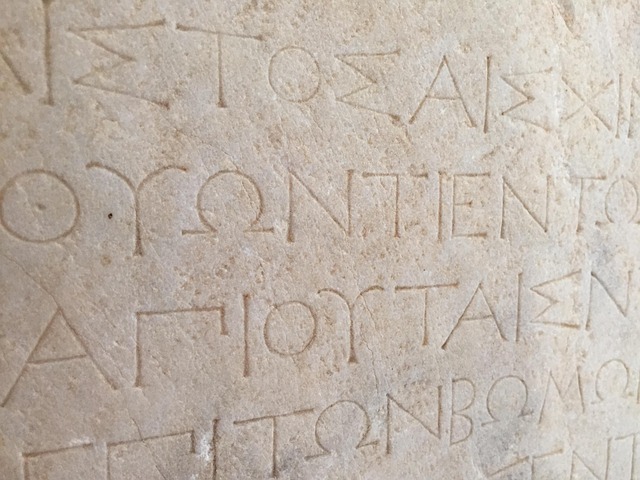
The Greek language has always been the beacon of our Nation; inexhaustible, luminous, capable of expressing the subtlest meanings and the highest ideas. It is not just a system; it is a homeland. A homeland of meaning, of memory, of the soul. When we speak Greek, we do not use words; we dwell within a tradition that spans centuries, in a memory that does not fade, in a light that does not set.
Every time we teach Greek, to the Greek diaspora, whether to beginners or advanced, whether to children or adults, we are not transmitting information; we are transmitting identity. We are transmitting ethos. We are transmitting the sense that a person is not only what he does, but also what he says, and especially the way in which he says it.
Engaging in ancient Greek, in the Iliad, in the midwifery method of Socrates, in philosophical dialogue, is not a philological exercise; it is an exercise of the soul. The dialogue about virtue, the Socratic quest, all of these constitute a path to truth.
Socrates did not teach from a pulpit; he taught from the heart. He did not impose the truth; he drew it out. He did not offer ready-made answers; he raised questions. And questions are always more important than answers. Because the answer closes; the question opens. The answer ends; the question begins. The answer quiets; the question worries. And worry is the beginning of philosophy.
When the student turns to the teacher, he doesn't just ask for knowledge; he asks for orientation. He asks to learn how to stand in the world. He asks to learn how to see. He asks to learn how to think. And the teacher, when he turns to the student, doesn't just offer information; he offers himself. He offers time, he offers effort, he offers soul.
Education is an exchange of souls. It is the moment when two people meet not to agree, but to seek. And the search is always common; never solitary.
In my articles on the Greek language I tried to show that language is not just structure; it is music. Every syllable is a pulse. Every word is a rhythm. Every phrase is a melody. And when a person speaks Greek, he participates in a symphony that began thousands of years ago and continues to this day.
When we speak Greek, we do not use words; we dwell within a tradition that spans centuries, in a memory that does not fade, in a light that does not set.
Over the years, I have written many articles about the language; sometimes about pronunciation, sometimes about teaching to beginners. Every time I wrote, I felt that I was not simply describing rules; I was describing a way of life. Because language is not a tool; it is a dwelling. A dwelling of meaning, a dwelling of the soul, a dwelling of memory. When you teach Greek, you are not transmitting information; you are transmitting identity. You are transmitting ethos. You are transmitting the sense that a person is not only what he does, but also what he says, and above all the way in which he says it.
And when you write Greek, you don't just write; you participate in an uninterrupted conversation of centuries. You converse with Homer, with Heraclitus, with Plato, with Papadiamantis, with Cavafy. You converse with all those who gave our language the form it has today. Every word is a bridge; a bridge that unites the past with the present, the present with the future, man with himself.
Our language is not just a tool; it is a string. A string that vibrates through time, a string that connects generations, a string that unites souls.
And literature comes to complement this music.
Cavafy, with his quiet wisdom, shows us that life is not straight; it is a circle. A circle that opens and closes, a circle that illuminates and darkens, a circle that teaches. His “Candles” is not just a poem; it is a mirror. A mirror in which we see the days that have passed and the days that are to come. His “Ithaca” is not just a journey; it is a destination that becomes a path. And the path is always more important than the destination.
Papadiamantis, with his language that resembles prayer, shows us that literature is not decoration; it is revelation. Revelation of ethos, revelation of the soul, revelation of the truth hidden in simplicity. In "Koutsoura", in "Travelers", in "Vardianos in Sporka", virtue is not theory; it is practice.
In "Vardianos at Sporkas", Skewo, the humble mother, dresses as a man to save her son from the plague.
There we see the meanness of virtue in all its power:
Inner middleness: maternal love that does not become a blind exaggeration, but a brave act.
External middleness: the balance between obedience and resistance, between fear and responsibility.
Social mediocrity: her attitude towards the community that mocks her; she does not retaliate, does not raise her voice; she endures.
Skew is not a heroine because she won; she is a heroine because she loved.
Nicodemus — the virtue of simplicity
Father Nikodimos, the hermit, has no secular education; he has an education of nature.
His virtue is not words; it is actions.
It is the virtue of the person who knows how to wait, to endure, to love without asking for anything in return.
The German Doctor — the Virtue of Compassion
Wilhelm Wundt, the German doctor, alcoholic, foreign, marginal, becomes the first to come to the aid of Skeos.
His virtue is not moral perfection; it is compassion.
And compassion is the most difficult form of virtue.
The women of Polichni, Gialinitsa, Piperou, Garbina, Alafina, constitute the opposite model.
There we see the lack of moderation:
the exaggeration of suspicion,
the lack of compassion,
the inability to see beyond themselves.
Papadiamantis does not condemn them; he understands them.
Because virtue is not a given; it is an exercise.
From Plato and Aristotle to Papadiamantis, virtue is not a moral commandment; it is a way of being.
It is the moment when man stands tall against the world.
To think rightly — to think with clarity, with judgment, with moderation.
to communicate properly — to share the word, to participate in the community, to build relationships.
To act rightly — to turn thought into action.
Virtue is the bridge between philosophy and life.
Tradition, with the customs of Lampri, with the mothers who shaped the ethos of Greece, with the people of folk wisdom, is the root that holds us up. Without roots, the tree falls. Without tradition, man is lost.
Tradition is not a past; it is a present that is constantly renewed. It is the moment when man remembers who he is, where he comes from, where he is going.
The humble people of folk wisdom, those who had no titles, who had no fame, who had no power, are the true bearers of tradition. Their wisdom was not theoretical; it was experiential. It was the wisdom of the man who knows how to wait, who knows how to endure, who knows how to love.
Spirituality comes to give depth to all of this. Faith is not a dogma; it is breathing. It is the moment when man raises his eyes from the earth and looks at the sky. The moment when he understands that he is not alone. The moment when he feels that there is something greater than himself.
In "I Believe," about the Holy Spirit, about the Ten Virgins, I tried to show that spirituality is not a theory; it is an experience. An experience that cannot be described; it is only experienced.
History, with its wounds and its miracles, teaches us that man is not only present; he is also past. May 29, 1453 is not a date; it is a wound that does not close. A wound that reminds us that freedom is not a given; it is a struggle. A wound that reminds us that identity is not a gift; it is a responsibility. A wound that reminds us that memory is not a burden; it is a strength.
Memory is the great book of the soul. It is not written with ink; it is written with experiences. It is not kept on pages; it is kept in hearts. And every time a person remembers, he is reborn.
Modern man struggles. He struggles with the demographic crisis, with the merchants of nations, with the signs of the times, with luck and fate, with the future of the homeland, with the responsibility of the youth. He struggles to find meaning. He struggles to find orientation. He struggles to find light.
And the light is always found in the word. For the word is the beginning of all things. And man is a being of the word.
Speech unites. Speech illuminates. Speech transforms. Speech is a journey. And the journey continues.
And yet, no matter how much speech illuminates, it never ceases to be a shadow. A shadow that spreads behind every word, behind every memory, behind every action. Because man is not only what he says; he is also what he remains silent. And within his silence lie the deepest truths.
Man struggles between light and shadow, between knowledge and ignorance, between hope and fear. And education, language, tradition, spirituality, history, all of these are not just thematic units; they are paths. Paths that lead man not just to knowledge, but to transformation.
Language, education, philosophy are connected in a secret way. When a person learns to speak, he learns to think. When he learns to think, he learns to live. When he learns to live, he learns to hope.
And hope is the deepest form of education. Because education without hope is a mechanism; education with hope is light.
Ladies and gentlemen,
Reason is the beginning of everything.
And man is a being of speech.
If our speech is pure, our life will be pure.
If our word is true, our life will be true.
If our speech is bright, our life will be bright.
Today we completed a course.
A journey through language, through tradition, through the soul.
A journey that never ends; it continues.
Because reason is a process.
And the journey continues.
EPILOGUE
Composition of all the topics:
Greek education as a unified body of philosophy, language, history and spirituality.
Kind regards
- The soul that does not fear the weight of truth becomes a wing and lifts nations.
photo AJEL, https://pixabay.com