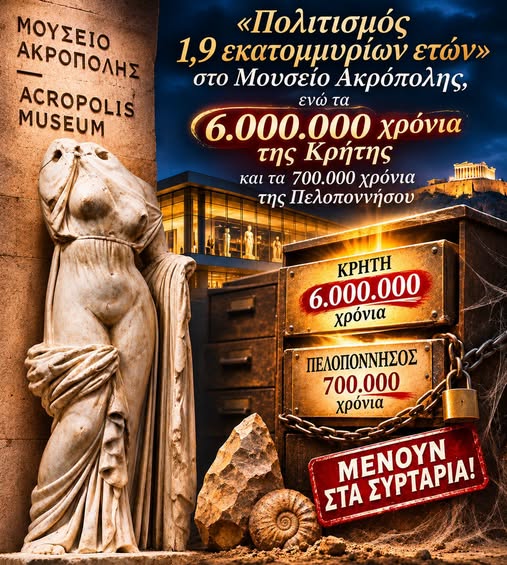
"1,9 MILLION YEARS OLD CIVILIZATION"
Written by Dionysia Klarinetatzi
Today, November 20, 2026, the temporary exhibition "Ancient Armenia" opens at the Acropolis Museum.
On the occasion of the inauguration, a CNN Greece article was published with the impressive title: ""Ancient Armenia": An unknown 1,9 million-year-old civilization is revealed at the Acropolis Museum."
Hosting exhibitions of a historically fraternal people like the Armenians is certainly welcome and makes us happy. However, the way in which the news is presented and the silence that prevails regarding the corresponding and even more ancient findings in the Greek region reveals two harsh truths:
first, how the deep prehistory of Greece is systematically downgraded, and second, how the very Greek roots of Armenia are silenced!!!
1. Double standards: When stone tools from other countries are called "civilization", while Greek wonders remain in the dark
The number "1,9 million years" in the CNN headline does not refer to a naturally organized ancient civilization with cities and writing, it refers to primitive stone Paleolithic tools of early hominids found in the Caucasus.
And here the relentless question arises: Why, when it comes to stone tools outside Greece, do the headlines celebrate a "1,9 million-year-old civilization" and the halls of the Acropolis Museum open, while the shocking, world-class findings of Greek soil itself remain buried in warehouses and footnotes?
Let's talk about irrefutable scientific data that the mainstream media blatantly ignores:
Trachilos Kissamos (Chania, Crete) – 6.050.000 years: Fossilized humanoid footprints of bipedal walking, 6,05 million years old, the oldest on the planet! Instead of becoming a global symbol, they were left unprotected until vandals cut off pieces of them!
Mygdonia Basin (Macedonia) – Over 1.000.000 years old: Lower Pleistocene strata next to Petralona with stone tools and traces of early hominids, 1 to 2 million years old.
Marathousa Megalopolis (Arcadia) – 700.000 and 430.000 years: Official geoarchaeological research under the internationally renowned Greek paleoanthropologist Katerina Charvati (University of Tübingen) brought to light 700.000-year-old stone artifacts, as well as the oldest wooden tools in the entire world, 430.000 years old (official international announcement in January 2026)!
Plakias & Preveli (Crete) – 130.000 to 700.000 years: Hand axes that prove that human ancestors crossed the Aegean Sea in boats hundreds of thousands of years before what books taught!
Rhodafnidia of Lesvos (500.000 years old) & Petralona Cave: A priceless treasure of humanity, with the original Petralona skull locked away for 40 years in the drawers of the Aristotle University of Thessaloniki, while a plastic copy is exhibited in the museum!
When did the Ministry of Culture organize a major exhibition at the Acropolis Museum about the 6 million years of Crete, the 700.000 years of Megalopolis or the Archanthropus of Petralona? When did CNN write about "unknown Greek civilization of millions of years"? Never!
2. The truth that is being silenced: The ancient Greek root of Armenia
The second equally serious issue is the way in which the publication focuses almost unidimensionally on Armenia's relations with the East and Mesopotamia, omitting its own Greek identity and origin, as recorded by ancient sources:
The Thessalian hero Armenos (Strabo, Geographica): The leading ancient Greek geographer Strabo (Book XI, 11.4.8 and 11.14.12) explicitly preserves the tradition that Armenia took its name from Armenus, the Greek hero from Armenion in Thessaly (between Pheres and Larissa, on Lake Boebiida), who participated in the Argonaut Expedition alongside Jason and settled in the Caucasus, noting that even the traditional Armenian clothing testified to their Thessalian origin!!!
Ancient linguistic ties and the Greek alphabet: The Armenian language shares deep, ancient common roots with Proto-Greek, which is why until 405 AD the Armenians wrote their language using Greek characters, while the Armenian alphabet that was created at that time was structurally based on the Greek alphabet.
The Greek education of Armenia: In antiquity and the Hellenistic era, the Armenian court was a center of Greek culture: King Artabasdes II (1st century BC) wrote tragedies and historical works in ancient Greek, while in the capital Artaxata there was a Greek theater where Euripides' Bacchae was performed!!!
The conclusion
We do not diminish the history of any people, let alone a brotherly people like the Armenians... However, we demand from the State and the media to stop treating Greek prehistory as a poor relative.
Before we open the halls of the Acropolis Museum to admire "1,9 million-year-old civilizations" of other countries, let's finally open our drawers and museums so that the world can learn about the 6 million years of Crete, the 700.000 years of the Peloponnese and the truth of Petralona!
Dionysia Klarinetatzi
Article Author
ON SUNDAY 29/11 DON'T MISS THE SHOW "ARCHEGENOS KODIKA" ON GREEK NEWS AND RADIO FLORIDA ON THE TOPIC OF THE ARCHANTHROPE OF PETRALONA - A COMPLETE RESTORATION OF THE TRUTH
For more information about the world-class Paleolithic discoveries in our country, you can watch the interview with Professor Katerina Charvati about the world's oldest wooden tools in Megalopolis, which highlights the unique position of the Greek region in human prehistory.