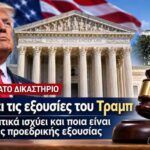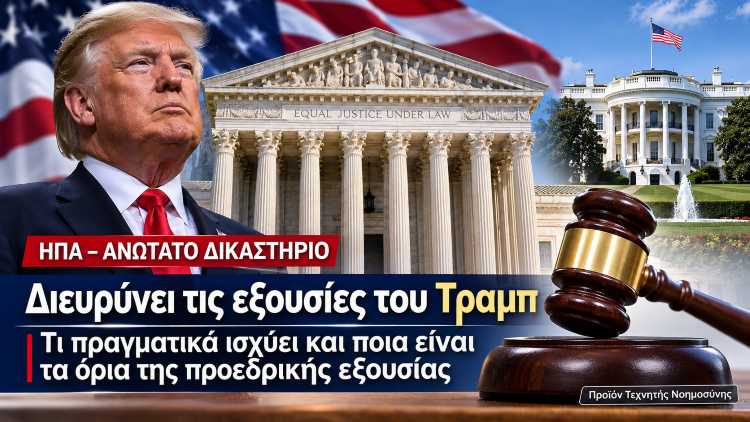
What really applies and what are the limits of presidential power?
Research – Reportage | Greek News & Radio FL
27 November 2026
Recently, reports have been circulating on social media claiming that the United States Supreme Court has granted President Donald Trump full and unlimited authority to remove federal officials, abolish independent agencies, and proceed with an extensive reorganization of the state apparatus without judicial or parliamentary restrictions.
Behind these posts lie real and highly important court decisions. However, several of the claims made do not correspond to their actual content.
The issue concerns one of the most significant institutional changes of recent decades in the United States: the relationship between presidential power, independent federal agencies, and constitutional control mechanisms.
The first important decision of May 2025
On May 22, 2025, the U.S. Supreme Court issued a temporary ruling in Trump v. Wilcox, allowing the Trump administration to uphold the removal of two high-ranking federal officials.
They are Gwynne Wilcox, a member of the National Labor Relations Board (NLRB), and Cathy Harris, a member of the Merit Systems Protection Board (MSPB).
The two officials had appealed to the Court, challenging the legality of their removal.
The Supreme Court suspended the decisions of the lower courts that had allowed their reinstatement, without at that time issuing a final decision on the merits of the constitutional dispute.
This development heralded a broader change in the interpretation of presidential powers.
The historic decision of June 29, 2026
The most significant development occurred on June 29, 2026, when the Supreme Court issued its decision in the case of Trump v. Slaughter.
By a vote of 6 to 3, the Court upheld the Trump administration's removal of Rebecca Kelly Slaughter from the Federal Trade Commission (FTC).
The decision overturned the landmark 1935 court precedent Humphrey's Executor v. United States, which for nearly nine decades had been a key legal foundation for protecting the independence of certain federal regulators.
With the new decision, the president gains the ability to remove members of the FTC without requiring the specific justification previously provided for by law.
The development creates an important legal precedent for other federal agencies with similar legislative protections.
What are independent federal agencies?
The United States has agencies created by Congress to exercise oversight, regulatory, and administrative powers.
Some of them were designed to have a degree of independence from the respective government, with the aim of limiting direct political interference in their operation.
Their responsibilities include consumer protection, labor law enforcement, competition oversight, energy market regulation, and protection of federal employee rights.
The president's ability to more easily remove members of their administrations may affect the priorities, policy, and operation of these organizations.
The important exception of the Federal Reserve
A particularly important point, which is omitted from many social media posts, is that on the same day, June 29, 2026, the Supreme Court issued a different decision in the case of Trump v. Cook.
By a vote of 5 to 4, the Court rejected the government's request to immediately allow the removal of Lisa Cook from the Board of Governors of the Federal Reserve.
The Court recognized the constitutional validity of the special protections governing the removal of members of the central bank's management.
The legal dispute over this specific removal was not definitively resolved with this decision.
The case is a clear example of the fact that expanding presidential power does not equate to the abolition of all institutional constraints.
Can Trump now fire all federal employees?
No. These decisions primarily concern the power to remove appointed officials exercising executive powers.
They do not automatically remove the legal protections of all federal employees, nor do they provide general authorization for unrestricted firings.
According to a legal analysis by the Congressional Research Service, significant questions remain open regarding the president's authority over junior officials and other categories of personnel.
Also, the power to remove an official is not the same as the power to abolish an organization established by an act of Congress.
Has the separation of powers been abolished?
The US Constitution provides for three main branches of power: the legislative, the executive, and the judicial.
Congress still has legislative, fiscal, and oversight powers. Courts continue to review the constitutionality and legality of government actions.
Supreme Court decisions alter the interpretation and application of constitutional provisions, but do not constitute formal constitutional revision.
The claim that the judiciary has ceased to function or that Congress has lost all of its powers is not based on these specific decisions.
The two different approaches
Supporters of expanding presidential power argue that officials exercising executive powers should be accountable to the elected president, who in turn is accountable to the citizens.
According to this approach, the enhanced ability to remove administrative executives allows the elected government to implement its policy more effectively.
On the contrary, critics of the decision express concerns about the weakening of the independence of the supervisory authorities, the possibility of political interference and the concentration of more power in the White House.
The disagreement concerns a fundamental question of American democracy: how to ensure the democratic accountability of the executive branch without undermining the independence of the institutions charged with implementing the law.
What about the rumored "great purge"?
Reports of the imminent removal of all politically dissenting employees, the abolition of independent organizations, and the beginning of the largest purge in the political history of the United States are political assessments and predictions.
They do not constitute content of the specific court decisions.
Similarly, the descriptions of "traitors" and "deep state" belong to political rhetoric and do not constitute judicial findings.
Conclusion
The United States Supreme Court has substantially expanded the president's power over certain independent federal agencies, overturning a landmark 1935 court precedent.
This is a historic institutional development, with consequences that go beyond the presidency of Donald Trump, as the new judicial precedent also concerns future American governments.
However, the separation of powers was not abolished, the American Constitution was not revised, and unlimited power was not granted to the president.
The real dimension of the decisions is in itself important enough, without the need to be presented through exaggerations or unconfirmed claims.
Sources and official documents
- US Supreme Court – Trump v. Wilcox, May 22, 2025
- US Supreme Court – Trump v. Slaughter, June 29, 2026
- US Supreme Court – Trump v. Cook, June 29, 2026
- Congressional Research Service – Legal Analysis, July 2, 2026
- Reuters – Expanding presidential power
- Reuters – The decision on the independence of the Federal Reserve
- Associated Press – Supreme Court decisions
https://www.youtube.com/watch?v=1QQLc7b9Mkw
https://www.youtube.com/watch?v=dL-iQ8dodEs
Greek News & Radio FL