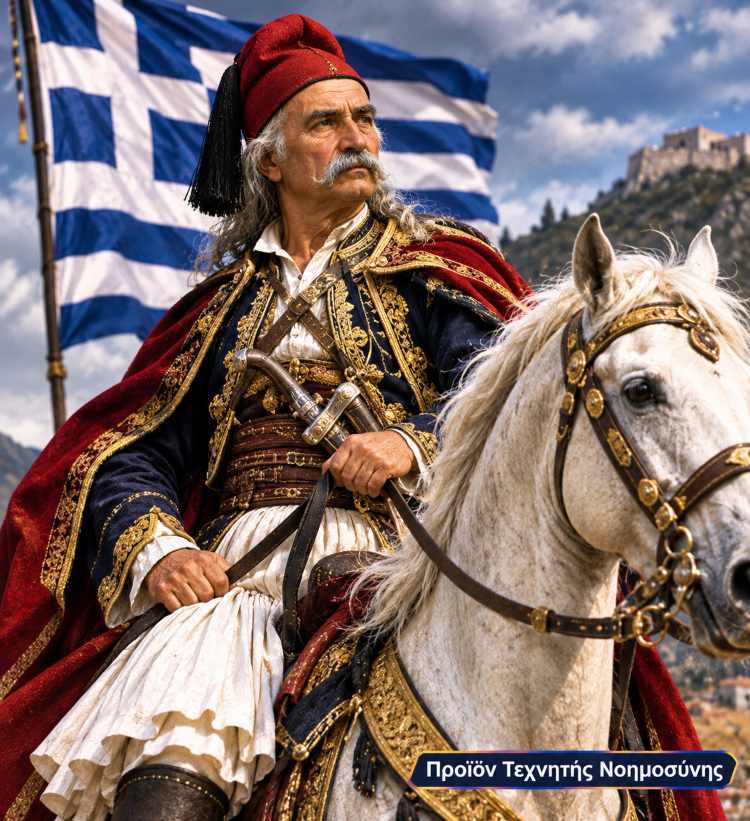
"Captain Lafyras."
(the correct one is Lafyras)
Maria Efthimiou accused Kolokotronis and called him "Captain Lafyras"
The historian's public statements Maria Efthymiou for Theodoros Kolokotronis have caused intense controversy in two different periods (the 2021 and August–September 2026).
The main points of criticism of Maria Efthymiou
Pursuit of political control and civil wars (2021). In interviews (on the occasion of the 200th anniversary of 1821), Ms. Efthymiou claimed that Kolokotronis tried to politically control the Revolution by imposing military rule ("military government"), which in her opinion led to the civil wars.
His action after Dervenakia (2021). He argued that, while his contribution at the beginning of the Struggle (Tripolitsa, Dervenakia) was decisive, he subsequently acted "harmfully" and failed militarily during the period when Ibrahim was sweeping the Peloponnese.
The nickname "Captain Lafyras" (2026). In August 2026, a new round of reactions erupted when she mentioned in a speech that Kolokotronis' nickname during the Revolution was "Captain Lafyras", wanting to propose a more demystified approach to the figures of '21.
The reactions and the counterargument
Her statements provoked severe criticism from historians, writers and political figures:
For the civilians and Ibrahim. Writers and historians (such as George Karabelias, Konstantinos Holevas and Ioannis V. Daskarolis) argued that Kolokotronis sought to avoid civil wars, was imprisoned by his political opponents in 1825 in Hydra and, when released, led the guerrilla war in the Peloponnese, keeping the Revolution alive against Ibrahim until the naval battle of Navarino.
For "Captain Lafyras". Historians and columnists (like the Meletis Meletopoulos) They publicly asked for primary sources. The counterargument focuses on the fact that there is no documentation that this was an established nickname of the time, beyond isolated reports from his political opponents. or later foreign authors (such as Maximilian of Kotsch and Gunnar Hering).
History has an inviolable rule: every categorical claim requires corresponding documentation. Especially when it concerns one of the most important figures in modern Greek history such as Theodoros Kolokotronis and when a specific characterization is presented as his established nickname during the period of the Revolution.Historian Maria Efthymiou has stated verbatim that Kolokotronis' nickname during the Revolution was... Captain Lafyras...Without Primary Sources
Now, Mrs. Efthymiou, I will save you an answer for your slanders against the fighters of 1821 who gave their lives so that you could be free today, because if they weren't there, you would be lost, locked away in some harem.
No Greek primary source from the era of the Revolution has been identified. (memoirs, letters, newspapers or documents of the Struggle) that mentions verbatim the nickname "Captain Lafyras" for Theodoros Kolokotronis.
This report is based solely on foreign language sources and to later literature:
Foreign sources of the 19th century. The nickname is found in the writings of foreign observers of the time, such as the German officer and philhellene Maximilian of Kotsch (1822-1823).
Later historiography. It is repeated in the work of the German historian Gunnar Hering (Political parties in Greece, 1821–1936), as well as in certain modern Greek historical writings that draw from this specific bibliography.
The position of Greek bibliography. In classical Greek works and in the testimonies of his contemporaries (such as Photakos, Kasomoulis, Makrygiannis, Spiliades, Trikoupis), as well as in the texts of the civil wars hostile to him, there are references to the management of the spoils and the enrichment of the chieftains, but the term "Captain Lafyras" is not recorded.
History has an inviolable rule: every categorical claim requires corresponding documentation. Especially when it concerns one of the most important figures in modern Greek history such as Theodoros Kolokotronis and when a specific characterization is presented as his established nickname during the period of the Revolution.
The primary Greek sources of the Revolution present two different views about his relationship Theodorou Kolokotroni with the spoils, depending on the political faction to which each author belonged:
The critical look (Makrygiannis)
Categories for enrichment. The general Ioannis Makrygiannis, who found himself in intense political confrontation with Kolokotronis' faction during the civil wars, directly accuses him of Memoirs of having become rich from the spoils of war.
The phrase for "Kiamilbey". In a characteristic turn of phrase, the Makrigiannis writes that Kolokotronis "became rich" and that together with his companions they became "Kiamilbeys" (likening them to the very wealthy Ottoman governor of Corinth, Kiamilbey.
The apologetic and realistic view (Kolokotronis, Photakos)
Kolokotronis' own narration. In his account to Georgios Tertsetis, he states that after the fall (Liberation and not fall because some want it) of Tripolitsa (September 1821) He attempted to collect the spoils in a central treasury, so that they could be distributed fairly among the military corps and the provinces for the needs of the war, but added with bitterness: "but who listened?".
The testimony of Photakos. His assistant, Fotios Chrysanthopoulos (Fotakos), in his own memoirs explains the function of spoils as the only means of survival and maintenance of irregular military corps (since there was still no organized state or regular payroll). He argues that Kolokotronis used whatever money or spoils he collected to pay, feed and equip his soldiers, in order to keep them on the battlefield.
Conclusion of the sources
In the reality of 1821, looting was universal practice for the financing of the Struggle (with few exceptions, such as Nikitaras). Kolokotronis' political opponents (such as Makrigiannis or the "government" in the civil wars) used the management of the spoils as an argument against him, while his fellow soldiers presented it as a necessary condition for the maintenance of the army.
The "plagiarism" and the dissolution of the camp. As soon as the city fell, every chieftain and soldier seized what he could. Kolokotronis reports that his men left for their villages laden with loot, with the result that within a few days the besieging force around the remaining castles (Patras, Nafplio) was dangerously weakened.
The use of spoils. Despite the disorder, much of this wealth returned to the Struggle: chieftains and dignitaries used the money they acquired to buy munitions, pay salaries ("loufedes"), and equip their troops in 1822, when Dramalis invaded.
The attitude of other chieftains towards the spoils
In the society of 1821, spoils were considered the legitimate right of the warrior ("his sword"), but the attitude of the chieftains differed markedly:
Nikitaras (Nikitas Stamatelopoulos). It is the most emblematic exception. He systematically refused to keep any loot for himself. In Tripolitsa he took only a sword and a mule (which he later gave away), while he did the same in Dervenakia. This attitude led him to die penniless and almost blind in Piraeus in 1849.
George Karaiskakis. He dealt with the spoils with purely practical and military mannerHe used them as an incentive to keep his unruly Roumeli warriors united, distributing them generously to his soldiers after victories (such as at Arachova). He was not interested in accumulating personal wealth, but in maintaining the power of his camp.
Odysseas Androutsos. In Central Greece, Androutsos was strongly accused by his political opponents of amassing huge sums of money and loot (mainly in Eastern Central Greece and his cave on Mount Parnassos), which he used to consolidate his absolute local power, operating independently of the central administration.
Petrobeis Mavromichalis. The Maniates participated in the liberation of Tripolitsa with their own customary law, considering the spoils as their main compensation, which they transported en masse to Mani.
The following is a summary of how money (spoils and loans) determined the civil wars, as well as what was the financial fate of the protagonists after Independence.
Goes on…