Thanksgiving: The historical truth behind Thanksgiving Day
A tradition that predates the arrival of Europeans in America, a story of sacrifice and survival, but also a historical reality that should not remain in the shadow of celebrations.
Today, Thursday, November 26, 2026, millions of people in the United States gather around the family table to celebrate Thanksgiving, a day dedicated to gratitude, family, love, and giving to others.
But how many know the real history of this holiday? How many know that Thanksgiving traditions on the American continent predate the arrival of the English colonists by many centuries? And how many know what happened to the people who helped the newcomers survive?
The historical retrospective is not intended to assign responsibility to current generations or to question the value of the celebration. It is intended to restore historical memory and recognize the contribution of the first inhabitants of America.
Native Americans and the ancient tradition of Thanksgiving
Long before the arrival of Christopher Columbus in 1492 and English colonists in 1620, the American continent was inhabited by numerous indigenous peoples, with different languages, cultures, social structures, and spiritual traditions.
These people, whom Europeans called Indians, had developed a special relationship with the land and the natural environment.
For the Wampanoag, like many other indigenous peoples, gratitude wasn't an obligation on a specific day of the year. It was a way of life.
They held daily and seasonal thanksgiving ceremonies for food, harvests, and the goods of nature. They honored the Creator, the land, and the natural resources that ensured the continuation of their lives.
The Smithsonian Institution's National Museum of the American Indian highlights that the Wampanoag followed these traditions long before their encounter with English colonists and the establishment of Thanksgiving as a national holiday.
Therefore, the tradition of Thanksgiving in America did not begin in 1621. It already existed in the cultures of the continent's first inhabitants. The English, for their part, brought their own European and Christian traditions of Thanksgiving.
America was not an uninhabited continent
When Europeans arrived in the Americas, they did not discover an empty land waiting to be inhabited. They encountered peoples with a long history, organized communities, agriculture, trade relations, diplomatic alliances, and cultural heritage.
The area of present-day Massachusetts was inhabited for thousands of years by the Wampanoag.
Even before the arrival of the Mayflower, contacts with European explorers, merchants, and slave traders had already caused serious consequences.
Between 1616 and 1619, epidemics decimated many communities in the region. Entire settlements were deserted.
One of them was Patuxet, on whose land the English later established the Plymouth Colony.
The area, then, in which the colonists settled was not a land without history and inhabitants. It was the land of a people who had already suffered a huge human catastrophe.
The Mayflower and the arrival of the English in 1620
In 1620, the Mayflower carried 102 passengers from England to America. Among them were people seeking religious freedom and others who wanted to create a new life.
The first winter proved to be particularly harsh. Disease, cold, hunger, and the lack of proper living conditions led to the death of about half of the colonists.
The survivors did not know enough about how to cultivate the land and exploit the natural resources of the area.
In their effort to survive, the indigenous inhabitants provided significant assistance.
The people who helped the English survive
The contribution of Ousamequin, known as Massasoit, leader of the Wampanoag, as well as Tisquantum, known as Squanto, was decisive.
Squanto's personal story is particularly revealing about the treatment of Native Americans by Europeans. He was kidnapped by Europeans and taken across the Atlantic. When he managed to return to his homeland, he found his community decimated by epidemics.
Despite his tragic personal experience, he played an important role in communication between the colonists and the indigenous people.
The Wampanoag helped the English become familiar with local crops, particularly corn, and adapt to the new environment.
In March 1621, an agreement of peace and mutual support was concluded between the two sides.
The agreement also had a diplomatic nature, as the Wampanoag, weakened by epidemics, sought to strengthen their position against other neighboring peoples.
The fact, however, remains: the contribution of the indigenous people was crucial to the survival of the English colony.
1621 and the creation of the myth of the first Thanksgiving
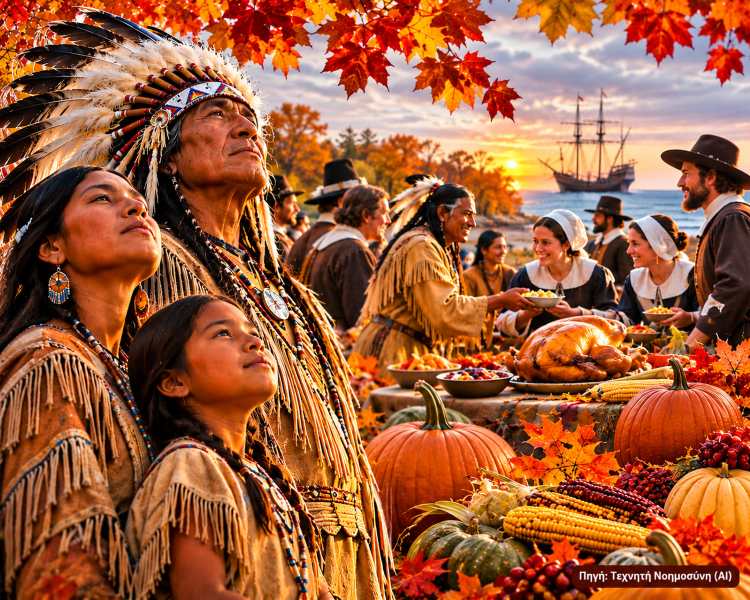
In the fall of 1621, after the successful harvest, a gathering was held in Plymouth attended by about 52 Englishmen and at least 90 Wampanoag.
The gathering lasted three days and included shared meals and festive activities.
The Wampanoag also contributed to securing food.
The main surviving written testimony about the gathering comes from the English settler Edward Winslow.
There is, however, insufficient historical evidence to confirm all the details of the image presented to later generations.
The exact date remains unknown, while it is not fully documented under what circumstances the Wampanoag arrived.
Furthermore, the 1621 gathering was not established as an annual national holiday at the time.
It took more than two centuries until 1841, when clergyman Alexander Young linked this particular historical encounter with the later tradition of Thanksgiving, describing it as the first thanksgiving celebration.
The image of the peaceful table presented for generations in American schools is, therefore, a simplified version of a much more complex story.
When European colonists thanked God for their military victories
A lesser-known side of history is that the religious thanksgivings of European settlers were not exclusively associated with the harvest and survival.
They were also organized as expressions of gratitude to God after military successes.
In 1637, during the Pequot War, one of the darkest pages of America's early colonial history took place.
Hundreds of Native Americans died in the Mystic Massacre, in present-day Connecticut, while survivors were captured and enslaved.
English colonies in the region declared days of thanksgiving for their military victories.
This historical fact does not mean that today's national holiday derives exclusively from this massacre. However, it does show that the term Thanksgiving was also used during the colonial period to celebrate military victories over indigenous populations.
This is a side of history that should not be silenced.
From coexistence to land grabbing
The peaceful coexistence symbolized by the 1621 gathering was not maintained.
As the number of European settlers increased, so did the pressure to acquire more territory.
Indigenous populations gradually found themselves faced with the loss of their ancestral lands, the violation of agreements, conflicts, enslavement and displacement.
In 1675, the war that became known as King Philip's War broke out, with the Wampanoag leader Metacom, son of Massasoit, the man who had concluded the peace treaty with the English in 1621.
The war had devastating consequences for the indigenous communities of New England.
The historical contradiction is shocking: within a few decades, the people who had contributed to the survival of the newcomers found themselves fighting to preserve their own land and freedom.
How Thanksgiving Day was officially established
On October 3, 1789, George Washington, the first president of the United States, issued a proclamation designating November 26 of that year as a day of thanksgiving and prayer.
The celebration had not yet acquired a fixed annual date.
The contribution of writer, journalist, and publisher Sarah Josepha Hale was decisive, as she had been advocating for a number of years for the establishment of a common national day of thanksgiving.
On October 3, 1863, during the American Civil War, President Abraham Lincoln established the last Thursday in November as a national day of thanksgiving.
His goal was to strengthen the unity of a deeply divided nation.
In 1939, Franklin D. Roosevelt attempted to move the date of the holiday for economic and commercial reasons.
Finally, in 1941, by decision of Congress and signed by Roosevelt, the fourth Thursday of November was established as the official Thanksgiving Day.
This is the institutional history of today's American holiday, which must be distinguished from the oldest indigenous Thanksgiving traditions.
National Day of Mourning: When the day of celebration becomes a day of mourning
In 1970, on the occasion of the 350th anniversary of the arrival of the Mayflower, Wamsutta Frank James, a representative of the Wampanoag, was invited to deliver a speech at an anniversary event.
The speech he had prepared referred to the real history of his people, the loss of their land, and the consequences of colonization.
The organizers did not accept his text in its original form.
The event was the starting point for the National Day of Mourning.
Since then, every year, Native Americans and their supporters gather in Plymouth to honor the memory of their ancestors and remind us that America's history did not begin with the arrival of Europeans.
On the same day that millions of families celebrate gratitude, many descendants of America's first inhabitants honor their historical memory.
Not all indigenous peoples approach the holiday in the same way. Some participate in family celebrations, others treat it as a day of mourning, and still others combine gratitude with the preservation of historical memory.
Native Americans are not just part of the past
Another major error of the traditional narrative is that it presents indigenous peoples as people who belong exclusively to history.
Indigenous peoples still exist. They maintain their communities, their cultural traditions, their languages and their distinct identity.
They are fighting for the protection of their rights, their sacred sites, their cultural heritage and their historical memory.
They are not just people who appear in the images of the first Thanksgiving. They are living people, with a history, a present, and a future.
Historical truth does not abolish the celebration
Recognizing the true history of Thanksgiving doesn't mean we should stop celebrating gratitude.
Nor does it mean that we hold today's Americans responsible for events that occurred centuries ago.
It does mean, however, that we must know history in its entirety and give each people their due place.
Native Americans thanked the Creator and honored the land long before the arrival of Europeans. The Wampanoag provided valuable assistance to English settlers, but later suffered the dramatic consequences of colonization.
These historical truths can and must coexist with today's message of gratitude, love, and solidarity.
History should not be written exclusively through the eyes of the victors. It must also keep alive the memory of those who lost their land, their freedom, and their lives.
History is not a category. It is knowledge, memory, and respect.
As we sit around the festive table today, it is worth remembering the first inhabitants of this land, their traditions, their contributions and their history.
Let us give thanks for what we have, without forgetting those who lost what they had.
Because gratitude acquires deeper meaning when it is accompanied by knowledge, justice, and respect for all peoples.
Happy Thanksgiving – Happy Thanksgiving to everyone.
Sources – Historical documentation
Smithsonian Institution – National Museum of the American Indian
https://americanindian.si.edu/
Smithsonian Magazine
https://www.smithsonianmag.com/
National Library of Medicine – Native Voices
https://www.nlm.nih.gov/nativevoices/
Plimoth Patuxet Museums
https://plimoth.org/
United States National Archives
https://www.archives.gov/legislative/features/thanksgiving
Library of Congress
https://www.loc.gov/
United American Indians of New England
https://www.uaine.org/
Greek News & Radio FL
https://greekradiofl.com