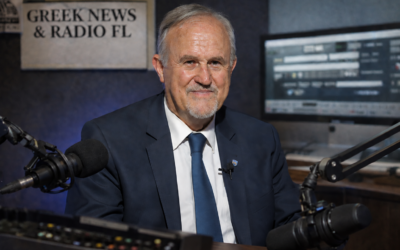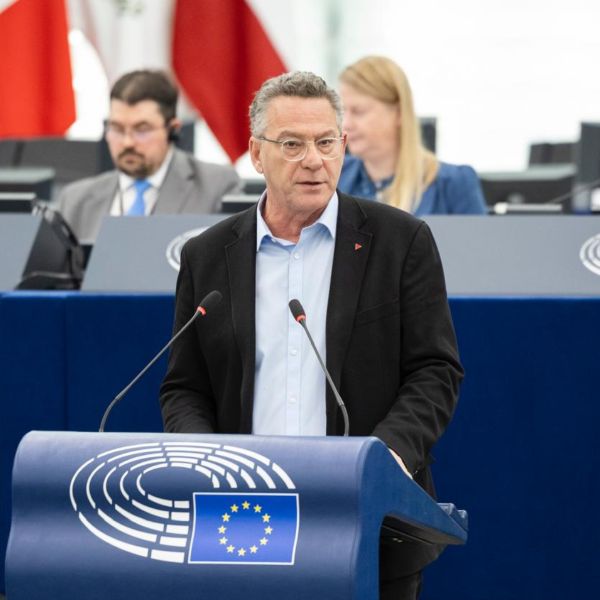
1. Mr. Arvanitis, we would first like you to tell us a few words about the actions you have undertaken both in the context of your role as Vice-President of the Left Group and as a Member of the European Parliament Committees.
As Vice-President of The Left and member of the LIBE and EMPL committees, my work focuses on the rule of law, labour rights and democratic accountability in the European Union.
At the level of the Left group, we work collectively for a fairer and more social Europe, strengthening the voice of citizens and protecting fundamental rights. Despite the conflicting priorities between member states, we choose to overcome difficulties, building alliances that serve the social majority and democracy, in cooperation with all political forces of the democratic arc.
In the Committee on Civil Liberties, Justice and Home Affairs (LIBE), I have taken initiatives on rule of law issues, such as wiretapping and freedom of the press, bringing these issues to the European level through interventions and parliamentary scrutiny. At the same time, I promoted the Tempi crime case, highlighting it as a matter of European responsibility and security.
In the Employment and Social Affairs Committee (EMPL), my work focuses on strengthening labour rights, promoting decent working conditions and safety at work, and supporting the most vulnerable social groups.
Particularly important is my role as rapporteur of the European Parliament for the European Commission's Annual Report on the Rule of Law 2025, where I am responsible for shaping the Parliament's proposals on the state of democracy in the member states, with an emphasis on media freedom, transparency and the protection of fundamental rights.
2. Do you believe that the EU will take initiatives to strengthen the trust of European citizens in its institutions? What could these be?
Citizens' trust in European institutions has been shaken, and not by chance. It has been shaken because citizens see every day an EU that operates on behalf of the interests of the few, to the detriment of the well-being of citizens.
They see European funds being directed to equipment instead of hospitals and schools, and housing, especially in Greece, “swallowing” their income. With all this, the new generation sees no perspective.
The Right-wing leadership of the EU presents the militarization of the European economy as a necessity, while in reality it is the way out that European capital is looking for to deal with the economic recession. The same leadership keeps the Union trailing the United States in NATO without taking any initiative for peace. Morally absent and complicit in the genocide of the Palestinians in Gaza, in Ukraine it followed Washington without leading, in the trade conflicts with Trump it found itself exposed and unprepared. This is not the behavior of a geopolitical agent that will inspire confidence in its citizens.
Furthermore, it is forcibly imposing the agreement with the Mercosur countries – by coup-bypassing the vote of the European Parliament and without waiting for the court ruling – paving the way for the European market to be flooded with cheap agricultural products produced under completely different standards and working conditions, directly harming farmers in Greece and the rest of Europe.
For the European Union to regain the trust of its citizens, it must respond to what directly affects them: social policies with substantial content, a rule of law that is applied without double standards, and a diplomacy that speaks with its own voice. Initiatives exist on paper. What is missing is the political will to implement them, because it disturbs the interests of those who effectively govern Europe.
3. How far away - or how close - do you think a new enlargement of the EU is?
The enlargement policy resembles a poorly maintained accordion. The conversation opens and closes, not when necessary, but when international conditions, and possibly even adventurism, dictate.
While our established strategy is the enlargement of the EU with the Western Balkans, this seems to be frozen and enlargement to the east is being prioritized.
There are contradictions and real problems here. The main problem is the circumvention of the basic principles of the rule of law in several Balkan countries, while significant problems were highlighted for Ukraine before Russia's invasion.
In the international context, the economic and political European elite seems to be content with the basic principles of the economic community and not with the fundamental principles of the European Union.
4. Climate change is an issue that is plaguing Europe and the entire planet. What should and what can be done now to mitigate the impacts?
The climate crisis is no longer a possible future scenario, but a reality. The EU must accelerate the transition to renewable energy, invest in resilient infrastructure and strengthen adaptation policies, especially for the most vulnerable regions.
At the same time, a socially just transition is needed. The cost cannot be passed on to citizens or the most vulnerable. Energy poverty and inequalities must be addressed with targeted measures, so that green policy also has social acceptance. Of course, in addition to purely energy issues, we must also be concerned with other climate-related issues, such as the great issue of water.
5. There is a need for targeted decisions and actions for island regions. What policies should be implemented in order to strengthen the acquis of insularity?
The difficulties faced by island regions are structural: increased transport costs, limited access to services and greater exposure to the climate crisis. The frequent shortage of professionals, such as teachers and doctors, as well as the housing problem are perhaps among the most visible challenges for our islands, while the trap of overtourism continues to pose risks. The problems, as we well know, do not end there:
We need the effective activation of the Transport Equivalent, better funding for infrastructure, self-administrative independence for greater absorption of EU funds, the protection of our islands with the provision of European legislation for island regions, and the strengthening of island energy communities.
6. Fishing and agriculture are issues that greatly concern our country. Given the many days of mobilizations in these sectors, what should be done to protect them and prevent them from shrinking even further?
The fisheries and agriculture sectors across Europe, but particularly in Greece, are under pressure from increased production costs, the unstable international environment and climate change.
However, at a time when the European Union's policy should ensure a decent income for producers and sustainability for the environment, we see that the Commission, with specific moves, such as the arbitrary implementation of the EU-Mercosur trade agreement, is anything but ensuring agricultural income, while the problem of zoonoses in our country is increasing more and more.
We have brought to the European Parliament the issues of Greek primary sector producers, the concerns of livestock farmers for their animals, fishermen who fish among schools of invasive species, farmers who have been deprived of the subsidies they were entitled to, beekeepers who see their income shrink. But beyond the individual sectors, what is needed is the revision of tools such as the CAP and the Common Fisheries Policy, so that small and medium-sized farms are effectively supported. At the same time, unfair practices in the market and protection from unfair competition through trade agreements are required.