Introduction: When the Word Becomes Destiny
In Greece, we have learned to give names almost mechanically: the name of the grandfather, the grandmother, a Christian saint so that the child may have his blessing or, as has become fashionable in recent years, an ancient Greek name because it simply "sounds beautiful"...
And yet, behind this seemingly simple family or religious habit, few know that we unconsciously continue an ancient, sacred law of millennia.
For our ancient ancestors, choosing a name was never a formal obligation, nor a superficial decision of the parents. It was an act of universal fixation, an unwavering vibrational seal that was imprinted on the incarnated soul at the very moment it entered the world of matter.
The ancients proclaimed with certainty: "The name is an ornith", the name is an omen, a sign, a premonition and a direction.
When the father and the community gave a name to a child, they were not giving him a social label. They were giving him his spiritual blueprint, his functional weapon, and the unwritten code within which his entire earthly existence was to move!
1. Law and Name: The Secret Etymological Relationship
To understand the magnitude of the mystery, we must return to the fundamental matrix of the Greek language.
The words LAW and NAME are not a coincidence. They come from the same ancient root of the verb nemo (to divide, distribute, render justice, determine a share).
• Law is the divine order that distributes justice, defines boundaries and gives each person their due in the Universe.
• Name (ἐν-νεμω, ὄ-νομα) is the specific share of consciousness, the share of existence and the particular law that is bestowed upon each soul.
The process of Naming was essentially an act of Legislation. To name a being meant to legislate its course through space-time. Every human being, throughout his life, did not simply bear a name: he obeyed the Law of his name!
When someone was pronounced by their name, the universal rules hidden in that particular vibration were automatically activated. As Plato notes in Cratylus, the supreme dialogue on the sacred correctness of names, names were not given at random by the many, but by the “Namer”, the profound connoisseur of the essence of things, who was able to capture the nature of the being in the sounds and consonants. The name was the phonetic embodiment of the very essence of man.
2. The Amphidromia and the Tithe: The Ritual of Energy Sealing
Naming was not done hastily, not even on the day of birth. The newborn was considered a being who had just crossed the veils of the invisible, vulnerable, formless, exposed to the invisible forces of the lower ethereal plane. A precise ritual was needed to connect it with the earthly home and the laws of the city:
The Amphitheater (The 5th or 7th day)
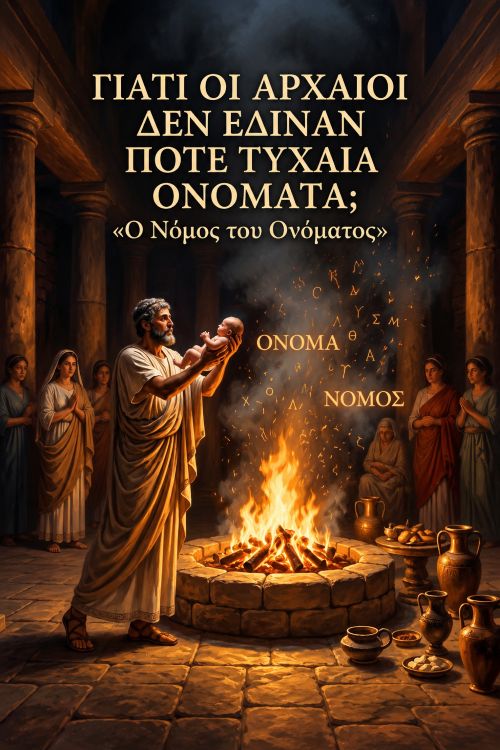
A few days after the birth, the women who assisted in the birth would ritually cleanse their hands and the house would be purified. Then, the head of the household, the father, would take the naked infant in his arms and run in circles around the sacred Hearth of the house…
The Hearth was the center of domestic worship, the living fire that united the family with the gods and ancestors. With this circular procession, the infant was “baptized” in the primal light, officially recognized as a member of the generation and energetically shielded.
The Tithe (The Day of the Law)
On the tenth day after birth, when the number ten (the Pythagorean Tetraktys, the symbol of universal completion) closed the child's first life cycle, relatives and friends were summoned to a formal sacrifice and celebration...
There, above the smoke of the sacred sacrifices, the father announced the Name aloud for the first time. By pronouncing the name before the visible witnesses and the invisible deities, the soul was irrevocably linked to its destiny.
The naming had taken place: the Law had come into force!
3. The Three Gates of Naming: How They Chose the Child's Fate
Our ancestors did not choose words randomly. Ancient names were complex mental constructs, divided into specific categories that activated corresponding energy fields:
A. The Compound Names of Virtue and Glory
The vast majority of Greek names were compound, consisting of two strong roots that together constituted a lasting command, an energetic wish, and a commitment to the community:
• Alexander: From the verb ἀλέξω (to repel, protect, fight for) and the word ἀνήρ / άνδρως. It does not simply mean brave but means “the defender of men,” one who puts forth his chest to ward off danger from his people. How coincidental is it that the son of Philip and Olympias lived precisely as the universal shield and the undisputed leader of men?
• Pericles: From περὶ (around, beyond measure) and kleos (glory, splendor). He was the one who is surrounded by supermundane glory. And indeed, the century of Athens' heyday went down in world history with its own name: the "Golden Age of Pericles."
• Demosthenes: From demes and sthenos (internal strength, power). His name called him to be the voice and strength of the people against any external threat.
B. The Theophoric Names (Divine Protection)
When parents wanted to place the child under the direct protection of a specific cosmic force or to express gratitude for its birth, they chose a name associated with the Gods:
• Diodorus / Theodore: The gift of Zeus or God.
• Herodotus: The one given to Hera, the protector of law and cosmic order.
• Apollodorus: The one blessed by the abundant, revealing light of Apollo.
The theophoric name functioned as an invisible coordinator: each time the person was called, their consciousness was tuned to the specific archetypal frequency of the deity who supervised them.
C. The Continuity of Blood and Ancestor Worship
In the ancient Greek world, the family was not a modern nuclear unit cut off from the past, but an unbreakable link in an eternal chain of souls.
The firstborn son almost always took the name of the grandfather on the father's side. This was not done for reasons of politeness. It was the energetic revival of the ancestor. They believed that the name kept the genetic and spiritual legacy of the house alive, allowing the virtues of the elders to flow unhindered into the new generations!
4. The Meaningful Names: When the Universe Speaks First
There were cases where the name was not chosen by the parents based on tradition, but was imposed on them by the events themselves. A significant event at birth or a special characteristic functioned as a prophetic epiphany.
• Odysseus: In the Odyssey, Homer captures the poignant moment when his grandfather, Autolycus, visits his newborn grandson in Ithaca. When Eurycleia asks him what name to give him, Autolycus remembers the many angers and enmities he has faced in his life and says: “Because I came here angry (ὀδυσσαμενος) with many, let him be called Odysseus” (from the verb ὀδυσσομαι, one who is hated, causes pain and also suffers pain). Odysseus’ name prophesied with absolute accuracy his entire tragic, long-suffering but indomitable fate in the waves and wars.
• Plato: The real name of the greatest philosopher was Aristocles (descendant of excellent glory). However, his wrestling coach, Ariston of Argos, observing his unusually broad chest and broad forehead, began to call him Plato (from broad). This nickname was not accidental: it expressed with absolute inner precision the breadth of his intellect, the broad worldview that would embrace the entire Western thought for the next millennia. Aristocles retreated before Plato's Law.
5. The Change of Name as Initiation and Transformation
Precisely because the name was inextricably linked to the state of the soul, when a person changed spiritual level or took on a new, higher mission, his name had to be changed. Keeping the old name would keep the consciousness bound to its old state.
• From Alceides to Hercules: The greatest hero of antiquity was born with the name Alceides (descendant of Alcaeus, full of elk/strength). However, when he was before the Oracle of Delphi, the Pythia refused to address him by that name. She called him Hercules for the first time (“Hera” + “kleos”). This name was not a reward, but the law of his spiritual ordeal: it decreed that his immortality would be gained exclusively through the struggle with dense matter (Hera) and the completion of his labors. Only through his new name did he reach apotheosis.
• From Myrtalis to Olympias: Alexander the Great's mother was born Polyxena, then named Myrtalis during her initiation into the mysteries, and finally received the sacred name Olympias from Philip II, sealing her connection with the sacred mountain of the Gods and victory in the Olympic games. Each name marked a radical leap in her personality.
6. The Healing and Magical Power of Vocal Vibration
In the ancient Asclepia and the mystery centers of Eleusis and Samothrace, it was known that each sound of the Greek language corresponds to specific energy frequencies. The consonants structure form and matter, while the vowels infuse spirit and life.
When a name was pronounced correctly, it produced a specific harmonic pulse. If the name was dissonant, if it did not match the child's temperament, the ancients believed that it caused internal disharmony and illness. On the contrary, a name given accurately functioned as a constant invocation of power, a shield of protection that renewed the vital energy of its owner at every step.
The Inner Calling: What Is Your Law?
Ancient knowledge of naming is not a museum fossil. It is a mirror pointed directly at us.
It invites us to ask ourselves: Do we know what the meaning of the name we carry is? Have we ever wondered what vibration is activated every time someone calls us on the street? Do we obey the Law of our own soul or do we live cut off from the divine seal given to us?
The ancient Greeks taught us that nothing in the Universe is without purpose. The moment a creature acquires a name, it enters the great tapestry of Universal Justice. Your name is not simply the way others call you. It is the sacred motto by which the Universe recognizes you.
When you discover the inner essence of your name and align your life with its power, you cease to wander like a random passerby in the world. You become what you were meant to be: the conscious legislator and executor of your own divine destiny.
Do you know what your name really means? Write it in the comments and let's discover its ancient Greek root together!
Dionysia Klarinetatzi
Article author
Ancient Sources & Evidence for the Article:
1. On the sanctity, correctness of names & the "Namer":
•Plato, Cratylus (388d-391b, 400d-408d): The fundamental dialogue on the etymology and universal correctness of names. There, the role of the “Lawgiver/Namer” who assigns the name according to the true nature of the being is analyzed.
•Plato, Timaeus & Laws: On the relationship between cosmic Law, harmony and the distribution of roles in the soul.
•Aristotle, On Interpretation (16a-16b): On the nature of the names and symbols of the soul.
2. For the Amphitheater, the "Tenth" & the rituals of Hestia:
•Aristophanes, Birds (p. 494 & 922-924): Recording of the "Tenth" ceremony, during which relatives were summoned, a sacrifice was made and the father announced the name.
•Hesychius of Alexandria, Lexicon (entries: "Amphidromia", "Dekatin thyein"): Detailed description of the father's purifying run around the sacred Hearth with the infant.
•Suda (Suidas Dictionary): Lemma "Amphidromia" – the purification of the 5th/7th day and the official naming of the 10th day.
3. For symbolic names & the principle "Bird Name":
•Homer, Odyssey (T 405–412): The scene where grandfather Autolycus gives the name to Odysseus ("ὀδυσσάμενος… ὀδυσσεὺς ὄνομ' ἔστω"), directly connecting the name with his suffering and future fate.
•Diogenes Laertius, Lives of the Philosophers (Book 3, "Plato"): The testimony that Plato's real name was Aristocles and was renamed Plato because of the breadth of his sternum and his intellect.
•Aeschylus, Agamemnon (p. 681-690): The classic example of a prophetic name ("Helen – ἑλεναυς, ἕλάνδρος, ἑλεπτολις"), where the name foretells fate.
4. For the initiatory renamings (Hercules, Olympias):
•Apollodorus, Library (2.4.12): The renaming of the hero from Alcides to Heracles by the Pythia at Delphi, as a condition and command for his labors.
•Plutarch, Life of Alexander (2.1-3.9): The renaming of Alexander's mother (Polyxene / Myrtalis / Olympias) and the connection of the name with Philip's victory at Olympia in 356 BC.