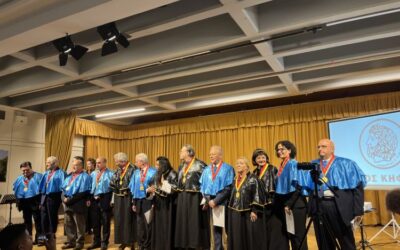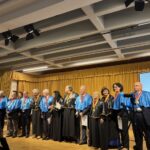

The Institute of Folk Culture of Karpathos (I.L.P.K.) of the Department of Philology of the University of Athens organized, with the cooperation of the Municipality of Karpathos - and personally the Mayor Ioannis Nisyrios and the Deputy Mayor of Development Strategy, Tourism, Municipal Project Planning and Communication Emmanuel Paragyou - during the period from November 6 to 12, 2023, University Postgraduate Courses in Folklore, Seminars and Field Research, spread throughout the island.
The courses were attended by 14 Postgraduate Students from Greek Universities and, as always, Educators of the island and any interested resident of Karpathos, having declared their participation (free of charge) to the President of the Board of Directors of the Central Branch, also had the opportunity to participate in them of I.L.P.K. Ilias Emm. Vassilaras and to the members of Popi Ioannidou, Roula Katogiritou, Sofia Konstantis and Sofia Georgiadis-Bon. Everyone was even granted a Certificate of Attendance, provided that they had attended all the presentations of at least 4 out of the 6 total days of the Conference.
The Folklore Presentations were held every day in a different village of Karpathos, in order to allow as many people as possible to attend them, but also to enable the Scientific Staff to carry out Field Research and Round Table Interviews, collecting even more data about the unique folklore wealth of the island.
Participants in the Teacher Program were as follows (in alphabetical order):
- Minas Al. Alexiadis – Emeritus Professor of Folklore at the Philology Department of the Faculty of Philosophy of the National Kapodistrian University of Athens (EKPA), President of the Hellenic Folklore Society and President/Director of the Governing Committee of the I.L.P.K.
- Manolis Varvounis – Professor of Folklore at the Department of History and Ethnology of the Democritus University of Thrace and Dean of the School of Classics and Humanities of the Democritus University of Thrace
- Dionysios Kalamakis – Professor of Byzantine Philology at the National Kapodistrian University of Athens and Director of the Department of Byzantine Philology and Folklore of the Greek Academy of Sciences
- Giorgos Kouzas – Assistant Professor of Urban Folklore at EKPA
- Athena Maha – Assistant Professor of Folklore at the Department of History and Ethnology of the Democritus University of Thrace
- Walter Puchner – Emeritus Professor of Theater Studies at EKPA
- Vasiliki Chrysanthopoulou – Associate Professor of Social Folklore at the Department of Philology of the Greek Academy of Sciences
and
- Ilias Em. Vasilaras – Researcher of Carpathian Folklore and Chairman of the Board of Directors of the Central Branch of the Institute of Popular Culture of Karpathos
The program of the Folklore Conference Presentations entitled "Historical and contemporary approaches to the study of folk culture with an emphasis on Karpathos" was as follows:
- Tuesday, November 7, Pigadia
- Wednesday, November 8, Aperi
- Thursday, November 9, Olympos and Diafani
- Friday November 10, Spoa and Lefkos Mesohori
- Saturday November 11, Pyles
- Sunday, November 12, Menetes


On Tuesday, November 7, the participants -Teachers and Students- in the Program first visited the Archaeological Museum of Karpathos, in Pigadia, which is housed in the western wing of the Eparchiio, an impressive building complex, from the period of Italian rule, which dominates the urban landscape of the capital Island's. This timeless Museum includes exhibits from prehistoric to post-Byzantine times.
Afterwards, the entire group went to the Vatha region and to the Carpathian lyre workshop of Giorgos Katogyritis, with the aim of on-site research and interviews both with Mr. Katogyritis and with the present instrumentalists and their coordinators: Vasiliki Chrysanthopoulou, Ilias Vasilara and Anastasia Phylaktakidou , Head of the University Sports Department of the University of Ioannina.
First, Emeritus Professor Minas Al. Alexiadis, who warmly thanked for their presence and their important help in this specific section of the Program, both Giorgos Katogyritis - who extended a warm welcome and hospitality to everyone - and the instrumentalists Michalis Tsampounieris (lyre), Costas Anousis and Nikos Orange (lute). He was succeeded by Ilias Vassilaras, who started with the presentation of Giorgos Katogyritis, inviting him to talk about his love for the lyre, which is evidenced by the many dozens of instruments that flood the space in which he welcomed us, which the Vasiliki Chrysanthopoulou described it as an "informal apprenticeship workshop". Mr. Katogyritis emphasized that he will not stop making lyres until he achieves the perfect sound! For the last 2,5 years he lives permanently in Karpathos and deals with his passion, but for the previous 35 years - out of the 55 that he lived in America in total - he came to Karpathos every winter, where he also made lyres, before returning to Virginia in the Spring Beach, in order to reopen the shop he kept there.
He has donated a lyre of his own making to the President of the Republic Katerina Sakellaropoulou, who is hosted at the Presidential Palace, accompanied by the following mandinada, by Kostas Tsampounieris, a lyre player himself and father of Michalis, the lyre player of the current group:
In order to live, I will keep the bow of the lyre
to play to Charon as if he's coming to get me.
Michalis Kon. Tsampounieris emphasized, among other things, that he has been playing the lyre since the age of 7-8, which he was first taught by his father Kostas, he took up the mesoura - as he characteristically pointed out - at the age of 16, while then he went to the army and then to America. In 1968 he paid 29.000 drachmas - as much as for a plot of land in Marousi! - for his "daughter", as he fondly calls the lyre, which he still has today.
The youngest Kostas Anoussis, from Spoa, emphasized that the feast unites the Carpathians and that the tradition of the Carpathian feast has been passed on to the younger generations of the island, at least for the villages around his particular homeland, which he knows himself.
The afternoon part of the Folklore Conference Presentations was hosted at the Church Hall of Panagia Evangelistria in Pigadia and effectively marked the start of the Postgraduate Courses. The first part of the event included greetings to the large audience, with Professor Emeritus Mina Al. Alexiadis, to take the floor first by addressing warm thanks to all the participants, Students and Professors, to Ilias Vassilaras (President) and all the members of the Board of Directors of the Central Branch of the I.L.P.K. and of course to the Mayor of Karpathos Ioannis Nisyrios and the present at the opening event Deputy Mayor Emmanuel Paragyos, without whose help, as Mr. Alexiadis pointed out, the successful organization of the Program would not have been achieved. The Deputy Mayor, in his own greeting immediately afterwards, first thanked all the Professors for their honorable presence for the island, as well as the Students and praised Professor Mina Al. Alexiadis, for his contribution to his birthplace.
The Police Director of Karpathos Ioannis Tsakirakis stated that he was impressed by the conduct of this Program in Karpathos, while Ilias Vassilaras, who succeeded him at the podium, assured everyone that they will leave the island much richer in knowledge about Karpathos, and wished everyone a good stay .
Professor Dionysios Kalamakis emphasized that it is not usual to have an Institute of such scope on an island, out of the dozens that our homeland has. But always, behind such efforts, there is a person who is the soul of the whole case, which in this case is none other than Mina Al. Alexiadis.
Finally, Professor Manolis Varvounis referred to the future of Folklore Studies in Greece, of which on-site research is an integral part. Even today, the on-site research yielded at least one thesis about Karpathos, the Professor emphasized.
The lectures of the participating Professors followed in the following order:
1) Minas Al. Alexiadis – Introduction to Folklore Carpathology
2) Walter Puchner – Oral storytelling and its genres. Greece and the Balkans
3) Vasiliki Chrysanthopoulou – Migration, Diaspora, osmosis and “returns” of elements of popular culture
4) Giorgos Kouzas – Karpathos in Athens: Carpathian restaurants in the center of Athens
On Wednesday, November 8, the mansion of Aperi, the educational capital of Karpathos for almost two centuries - from 1700 to 1892 - as long as the dangers from the sea and the weather guarded, welcomed the participants in this round of Postgraduate Courses, impressing everyone with its aristocratic splendor and the exemplary hospitality of its inhabitants. Seat of the Metropolitan of Karpathos and Kasos - the smallest in Greece - invites its visitors to wander through the picturesque streets of Valantou, to admire the imposing mansions in Pano Aperi, but also the churches of the districts of Agios Vassiliou, Agios Charalambos and not only, as well as the impressive residences of the Aperites, most of them renovated according to the traditional architecture of the place, despite the fact that most of the inhabitants of the village are immigrants, mainly to the USA.
First we visited the surrounded and impressive in size Metropolitan I.N. Dormition of the Virgin, which solemnly celebrates on August 15 and has connected its history with brilliant religious and historical events of the place, as the receptions of two Ecumenical Patriarchs, the blessed Athenagoras and the current Bartholomew, took place here, as well as the enthronements of many Metropolitans Karpathos and Kasos. Reverend Father Dimitrios Zagoras guided us through the space and time of the village and the church, before whom Professor Emeritus Minas Al. Alexiadis, who thanked the priest and all the Aperites for their warm welcome.
Then everyone moved to the perfectly organized and decorated premises of the Aperio Ecclesiastical Building, where greetings were first addressed to the participants in the Postgraduate Course Program, but also to the students of the Aperio High School, who also attended the lectures of the distinguished Professors. Professor Minas Al. Alexiadis made a short introduction, in order to outline the specific action of the I.L.K.P., but also to thank once again all those who in any way helped in the successful organization and conduct of it. He was succeeded on the podium by the hyperactive Sofia Oikonomidou, President of the Beautician and Cultural Association of Aperio "OMONIA", who emphasized that the establishment of the Institute is important and its offer invaluable, so that "OMONIA" could not in any case not is a member of The President briefly referred to the history of the Association and the village, ending with the adoption of the phrase that Professor Alexiadis had said during his previous visit to Aperi: "We Carpathians love our island in a torturous way".
Ilias Emm. Vasilaras, emphasized, among other things, that Aperi is an emblematic village of Karpathos, whose history would never allow it to be left out of the Institute's Course Programs. Finally, the Principal of Aperio High School, Stavroula Triantafillou, noted that she feels particularly happy to welcome the participants to the Program in her capacity, given that last year, from her position at another School in the Territory, she had collaborated in a folklore program with the Deputy Professor of Folklore of the Pedagogical Department of Primary Education of EKPA Rhea Kakaboura.
Lectures by the Professors followed:
1) Walter Puchner – The fantastic in the folk culture of the Aemos Peninsula, with special reference to Greece
2) Vasiliki Chrysanthopoulou – Folklore, Intangible Cultural Heritage and cultural policy in the Greek and international arena
Afterwards, Field Research and interviews with immigrants in the USA were carried out, coordinated by Professor Vasiliki Chrysanthopoulou. The participants were: Ilias Vassilaras, Sofia Oikonomidou, Fotini Gergatsouli – Stamatiadi, Kalliopi Bertou, Lilian Bertou, Popi Ladi and Panagiota Stamatiadi – Kaimara, who together moved the audience with their personal and family stories.
The day ended with a rich meal, always in the premises of the Ecclesiastical Hall of Aperio, with excellent art de la table that impressed us, as well as the high-quality dishes, with the signature of the renowned Carpathian chefs Thanasis and Andreas Diakos, of the well-known restaurant "Thalassa" .
Washed by the waves of the Aegean, Cretan and Carpathian seas, this long narrow piece of land looks like a bridge - geographical as well as cultural - between the "continent" of Crete and cosmopolitan Rhodes. Despite its central position, however, Karpathos seems to follow its own routes and rhythms. This island seems to have been untouched by time and its inhabitants - a strange thing and a great surprise - keep the traditions of their ancestors intact. The people of Karpathos managed to keep their soul intact, in defiance not only of their conquerors, but also - I would say mainly - of the modern trends of globalization and homogenization of everything. Tradition here is not something distant and "museum", which we simply respect, it is the living everyday reality, starting from the houses with the characteristic interior decoration, the women's costumes and the local language idiom, to finish with the age-old customs of the three-day Carpathian wedding and festivities, with local dances and the wealth of traditional purposes and songs!
Olympos, the folklore capital of Karpathos, condenses all of the above, perched on the mountains of its northern end and isolated until a few years ago from the rest of the island, with which it communicated mainly by sea. It impresses you from the first moment you see it at a bend in the road, coming from Pigadia, but it really shocks you when, walking through its picturesque streets, you realize that the natural environment and its residential architecture of the island, co-sign a landscape of unique beauty, that looks literally untouched by time! Beautiful houses with colorful concrete railings, arrays of stone windmills on the ridges of the mountains, old churches with the Dormition at the heart of the village, connected by a maze of alleys and stairs, creating a living folklore museum. And among all these the proud Olympians, with their impressive traditional costumes and their inimitable courtesy.
In Olympus, therefore, we were brought by the Program of Thursday, November 9, where we had the opportunity to carry out Field Research, with interviews and discussion with members of the local community and coordinators Professors: Vasiliki Chrysanthopoulou, Athina Maha and Giorgos Kouza.
First the woodcarver Kostas Tsampanakis, last President of the Olympus Community, before it joined the unified Municipality of Karpathos in 2010, welcomed us to his workshop at the entrance of the village and guided us through the paths of his art, revealing the sources of inspiration for the impressive designs that adorn the houses and the churches of the village.
The shoemaker Yiannis Prearis, or rather the last shoemaker and tanner of Olympus, introduced us to the way of making traditional handmade leather shoes, surrounded by strings, cowhides, leather and all kinds of tools, as well as men's or women's shoes with embroidery and patent leather or without, even with children's shoes or women's slippers, whose construction also follows the paths of tradition.
This was followed by the visit to Pericalli I.N. of the Dormition of the Virgin Mary, in the center of the village, where Pope John Diakogeorgiou, who in 1987 was ordained and appointed vicar of this historic church, told us in his unique way the history of the church and Olympus, fully justifying the designation "Ark of Olympic Folklore", attributed to him by Minas Al. Alexiadis, a description which he repeated during the presentation of a commemorative gift to Pope John, at the same time thanking him warmly for the impeccable hospitality of the entire group of Professors and Students in Olympos.
Next came the visit to the Vassilis Hatzivasilis Museum, where his son Giannis Hatzivasilis, a popular artist himself, guided us with his unique passion to the Museum-home of the popular painter and father of Vassilis Hatzivasilis. This private Museum first opened in 2009 and hosts a collection of works, as well as many of Hatzivasilis' personal items, and is housed in his family's house, which was built in 1969 and where Giannis was born. We must note at this point, that Professor Alexiadis, apt as always in his characterizations, calls Vassilis Hatzivasilis "Theophilus of the South Aegean".
Immediately afterwards, we went to the home of Reverend Fr. Giannis Diakogeorgiou, where we had the opportunity to enjoy the unique hospitality of the Elder of Peace, to taste her excellent mizithropitas, but also to watch her highly interesting discussion with Professor Athena Maha about the impressive decorated Carpathian house of Olympus and the Olympian women's costume. The pokamis, the breeches, the kava(d)i, the apron, the (t)belt and the scarf, make up the local costume - Professor Maha told us during the seminar that followed - which takes its name from the iconic kawai, the long, open-front garment worn by the Olympians.
This was followed by a short visit to the Church Hall of Olympus, decorated with wedding textiles, and then lunch at the "Olympos" tavern, where we enjoyed traditional dishes at their best, such as handmade macaroons with burnt butter and roasted onions, dolmades, fried pumpkin flowers and the fava bean.
During the meal we had the opportunity to watch the unique live presentation of the beekeeper Giorgos Chalkias, who transported us to the enchanting microcosm of this amazing insect, but also to taste his excellent honey. Pope-Yiannis Diakogeorgiou put us in the atmosphere of the Olympic feast with his wonderful voice, while Professor Minas Alexiadis presented us Karpathos at the beginning of the last century through the eyes of a child, who was none other than Yannis Kokkindis, one of the most successful Carpathian scientists and businessmen of America, who was born in Othos in 1901 and died in 2003 in Palm Beach. Kokkinidis refers in a moving way, in the context of a profound confession, to home, to school, to family, to the difficult years and to the war, but also to doctors and his great losses. We all applauded the initiative of the respected historian of Karpathos, Manolis Kassotis, who sent this excellent text to Professor Alexiadis, considering it timely in order to present it in the context of our Postgraduate Courses.
In the afternoon, the whole group went to Diafani, where we first watched the lighting of a wood-fired oven and traditional baking by Elena Chiraki, while then, at the Church Hall of Diafani, we participated in an interesting discussion with members of the village community, specifically with Doctor George Anastasiadis, the George Chatzipapas, elected President of the Local Community of Olympus and amateur botanist and writer Minas Agapios and Irini Chatzipapas – Tsapanaki, fava, wheat and barley producer in Avlona, but also the youngest woman who wears the traditional Olympic costume every day. All of them conveyed to us, each with their unique knowledge and from their own point of view, the love for their place, the memories, the problems, but also the anxiety for the future of Olympus, Diaphanio, Saria, Avlona, of Tristom and Brucounda.
Having traveled a total distance of approximately 25 kilometers from Pigadia, always heading north and having on our right the vast blue of the Aegean, which hugs the rugged body of the Karpathos, giving rise to landscapes of incredible natural beauty, painted in a thousand shades of green and blue , we arrived on Friday, November 10, almost without realizing it, at the beautiful mountainous and legendary for the hospitality of the inhabitants of the small village of Spoa, which somehow marks the center of the island, both in terms of its longitudinal axis and as to the fact that it is located at the "neck" of the island, where Karpathos narrows. The village thus enjoys an additional privilege, that of the magnificent view to both the "two seas", on the eastern and western sides of the island, as well as dreamy sunrises and sunsets! Surrounded by vines, olives and fig trees, the village is criss-crossed by narrow picturesque streets, which go up and down in its neighborhoods, intersecting with small churches, cafes, beautiful and well-kept traditional or more modern aesthetic houses, but also with the kind and hospitable people, as already we emphasized its inhabitants, the Spoites. Wherever you stand you will feel "at home" as everyone here will greet you, invite you for a treat, tell you stories, tell you about their manners and customs that are reverently observed and unchanged, invite you celebrate with them a religious anniversary or a local social event, where the lilting sounds of the lyre, the singing and the Carpathian feast will really blow your mind! Because the Spoites, above all else, are also maracles, in the sense that this word has here in Karpathos, characterizing the man who occupies a top position in the Carpathian feast, with his inspired mandinades, his flawless dance and his charismatic playing of local musical instruments.
The day's program began with a stop at the famous Windmills, which welcome the visitors as sleepless hosts, located right at the intersection between Spoo and Mesochori, in the Pyrgos area. There, the Field Research and interview with the experienced miller Manolis Chalkias, really put us in a world that has been lost forever. He told us about the mules that arrived loaded with barley and wheat from Spoa, Mesochori, Lasto and Volada, about the windmill that worked 24 hours a day, if the weather was favorable, producing even 24 kilos of flour a day, us he talked about the axai, the payment exclusively in kind that his miller father received and of course the owners of the other 200 mills in total in this area, given its favorable position for the utilization of the wind, which comes here "masouri", as characteristically, Mr. Chalkias mentioned to us, due to the fact that it is bordered on both sides by two mountain masses. He still spoke to us with emotion about what his father went through at the hands of the Germans.
The Interview was coordinated by Professors: Vasiliki Chrysanthopoulou, Athina Maha and Giorgos Kouzas.
Arriving in Spoa, we had the opportunity to visit two typical Sopite houses, which of course belong to the Carpathian house type, and to listen to what their gracious owners had to tell us, under the coordination of the aforementioned Professors, as well as the bronze Researcher of Carpathian Folklore Ilias Vassilaras, who comes from Spoa and has written thousands of mandinades about his beloved homeland, which I had the pleasure of studying, as part of my thesis for the Master of Folklore from EKPA. The first house belonged to Hatjinoula Piperi, who is named after her aunt, her father's first cousin who was killed at the age of 18, while the second house belonged to Maria Talaranda. Both hostesses welcomed us with richly laid tables, full of handmade sweet treats - Mrs. Hatjinoulas' almond paste-filled sykalakis were a hit - and told us about the history of their homes, describing to us the truly impressive interior of the traditional Soite houses, with the their elaborate decoration, the wood-carved furniture and mirrors, the frames with the photographs of the ancestors in a prominent position, the dozens of decorative plates and of course the famous sofa, the most formal part of the house, with its emblematic penkerchief - elaborate embroidery that covers the pillar, the wooden vertical beam in the middle of the room, symbolic and real support of the Carpathian house - and decorated with embroideries, silk fabrics, laces, but also quilts, pillows and everything else available to each household.
Then we went for a short pilgrimage to the parish I.N. of St. George the Drunkard -from the fact that on his feast day new wines are tasted for the first time-, who dominates Spoa and who celebrated on November 3rd with widespread participation and of course with the organization of the established traditional feast. We ended up at the adjacent Spoon Church Hall, where we were warmly welcomed by the lady members of the hyperactive and award-winning Spoon Women's Association "I Proodos". The program started with a greeting by Emeritus Professor Mina Al. Alexiadis, who thanked the present Spoitissesses and the entire village for the exemplary welcome they gave us and spoke of the proverbial kindness and hospitable attitude of the Spoitians. Then, in his capacity as President/Director of the I.L.P.K.'s Steering Committee, he presented a commemorative gift to Eleni Diakoliou, Member of the Board of Directors of the Women's Association -due to the absence abroad of President Fanis Maragakis-, while immediately afterwards the Vice-President Penelope Livaditi briefly told us the history of the Association, which was founded in 1984 and of which she was not only the first President, but also the inspiration behind its creation. Finally, Professor Alexiadis warmly thanked the Chief of Police of Karpathos Ioannis Tsakirakis for his honorable presence, who has a deep interest in the issues of culture and letters of the island and attended the entire program in Spoa, accompanied by Police Officer A' Marios Papadakis.
Ilias Vassilaras, as a native of Spoitis and President of the Board of Directors of the Central Branch of the Karpathos Institute of Popular Culture, could not fail to take the floor in order to guide us through the paths of the history of the village, which reached the middle of the last century until and the 400 souls, as evidenced by the ruins of houses, which once buzzed with life and children's voices. Mr. Vassilaras placed particular emphasis on the decoding of the toponym Spoa, which, as he pointed out, derives from the ancient Greek expression "es poda", which means towards the North, with this identification rather referring more generally to the southernmost regions of the territory of the ancient Carpathians city of Vrykountos, which spread across the northern part of the island. Finally, Ilias Vassilaras described to us the famous "Syrmata" - the ancient tug-of-war-, a unique Easter custom of the village -specifically on Easter Monday-, in the context of which the inhabitants are divided into two groups, one of men and one of women of all of ages, competing against each other by pulling a large rope from each side and trying to have one team pull the other to win.
This was followed by the Master's lecture of Professor Giorgos Kouzas, entitled "Consumption and modern urban space: Carpathian products in the open-air markets of Athens" and the program ended in the most "delicious" way, as the goldsmiths, benefactors of the village and members of the Women's Association, they cooked us live typical local recipes of their place, which we were then lucky enough to try, enjoying a truly unforgettable delicious meal with high quality products. In particular, the ladies Irini Annousi, Irini Chalkia, Penelope Livaditi, Hatjinoula Piperi, Eleni Diakoliou and Irini Annousi, prepared for us vegetable pies -baked vegetable pies-, fava beans, yaprakia or dolmaes, stuffed flowers -pumpkin flowers with a filling similar to that for yaprakia -, menule pastes - the emblematic for the local economy small fish, related to the marida, 20-25 cm long-, handmade "cut" macaroni - they differ only in terms of shape from macaroni and are served in the same way -, but and thin, fried wooden cakes, sprinkled with sugar. The discussion with the cooks was moderated by: Vassiliki Chrysanthopoulou, Giorgos Kouzas, Ilias Vassilaras and the writer, Katerina Marinaki, as a Postgraduate Student, but also a Gastronomy journalist.
In the early afternoon, we went to Lefko Mesochori, where we were welcomed by the Vice-Mayor Emmanuel Paragyios, who comes from the area, with his father, Master Yiannis Paragyios and officer Nikolaos Paragyios, Commander of the Karpathos Fire Service and keen diver, who really impressed us with the his knowledge of the area.
Lefkos, in the center of the island and towards its western coast, is nestled at the foot of Mount Lastos or Kalolimni, at an altitude of 148m, with the wider area - from the Potali River, the ridge of Kalolimni, the stream that flows into the Gulf of Laron and the entire coastline, including the island of Sokastro - hosts a multitude of antiquities from the early Christian to the Byzantine and medieval periods. We had the opportunity to visit, together with our hosts, one of the most important attractions of the area, the five-domed Byzantine church of Agios Georgios, inside which there are frescoes on two layers - the oldest dating from around 1300 - and which since 1950 has been designated as a Historical Monument. We also visited the Roman Reservoir of Lefkos, as well as rural settlements in the Rizes area, where we studied the structure of the rural houses of Karpathos up to the 60s.
In Pyles Karpathos, the village of Daskalon, the smallest in terms of population among the villages of the island, the program was hosted on Saturday, November 11, the penultimate day of the I.L.P.K. Folklore Conference Presentations program. Built on the western side of the island, the village and its amphitheatrically placed houses enjoy a panoramic view of the Carpathian Sea, dominated by the stone figure of the neighboring Heroic Island of Kasos, with the mountains of Sitia faintly visible in the distance. The sunset from here is truly unforgettable, as are the picturesque streets of the village, which are bordered by the flowery courtyards, while the area around Pyles is also drowned in the green of the many orchards.
Regarding their name, there are various versions, including the assumption that there were some gates - doors - or the village was a gate - passage, entrance -, which connected the villages of North and South Karpathos. In addition, there was - and is - a lot of clay, but also caves, from which it may also have been named.
Pyles, famous for the many good Teachers they gave birth to, took the name "the village of Teachers". In 1908, at the expense of the Ecclesiastical Committee, the school building was purchased and rebuilt from the ground up in 1925, which housed the three-seater at first, then a two-seater and finally a one-seater Primary School.
In 1985, the new school building was built, on privately owned community land, at the edge of the village, a modern educational center, excellently equipped with all modern electronic educational means.
Immediately after the arrival at the Gates of all Program participants, Professors and Students, we had the opportunity to carry out Field Research at the Open-Air Rural Museum of the Gates and the well-preserved Windmill, on top of a hill, with a panoramic view. The highly detailed tour was given by Yiannis Lachanas, Agronomist of the Municipality of Karpathos, coordinated by Professors Vasiliki Chrysanthopoulou and Athena Maha. The Open-Air Agricultural Museum of Pylos - unique of its kind in the Dodecanese - has been designed in such a way as to present life in Karpathos in the most realistic way possible and houses a farmhouse, with its winepress, threshing floor and oven, the windmill mentioned above, as well as a small amphitheater. Vines and various fruit trees have been planted in the surrounding area and the visitor can come into contact with the rural life of the past in Karpathos, but also the processing cycle of important products for the island, such as cereals and wine.
After a visit to the bust of the benefactor Urania Sevastopoulos-Kousourelakis of Pyliatsia, the woman who created Kousourelakeio, the first institution in Karpathos and a walk through the streets of the village, during the magical time of sunset, we ended up at the Ecclesiastical Building of Pylos, next to the Parish Church .N. Dormition of the Virgin, in the center of the settlement. Emeritus Professor Minas Al. Alexiadis opened the day's program of work with his greeting, emphasizing among other things: "I am particularly happy that we are in the village of Father Kallinikos, whose work spreads throughout Karpathos, and is unprecedented for a place of this size. I wish him to live out his years - like Professor Kriaras, who passed away completely lucid and productive at the age of 106 - and I also wish him to be qualified to take on higher ecclesiastical positions".
The All-Scientific Archimandrite Kallinikos Mavroleon, as Professor Alexiadis characteristically writes in his earlier article in "Carpathian News", is "an exuberant and composed personality, who develops a diverse and enviable activity in the society of Karpathos and outside it. Tireless, organizational and creative, he is particularly distinguished for his ecclesiastical and religious work, which is why he was chosen as Professor of the historic Holy Monastery of Agios Georgios Basson Karpathos, which is the only monastery on the island and its Catholic has been characterized since 1950 as historical preserved monument.
As an educator, and for many years Teacher and Director of the Monothesi Primary School of Pylon Karpathos, which was unexpectedly abolished by the Greek State, he left an era. He is the one who organized, in difficult years, a Model All-Day Primary School in a small community, where he founded a Student Cooperative with the main purpose of self-management of the School, introduced for the first time in Greece the teaching of lessons with electronic computers and published, with the collaboration of his students, the quarterly newspaper 'Our Village... Oi Pyles'".
Professor Minas Al. Alexiadis also thanked Agronomist Yiannis Lachanas and all the Associations, who took exemplary care of our hospitality - detailed below - and introduced the evening's speakers.
He was succeeded on the stage by the first of them, Professor Manolis Varvounis, who introduced us demonstratively and documentedly to "Religious Folklore" with the first part concerning the "Cycle of Time".
Professor Dionysios Kalamakis followed, who developed the interesting topic "Teaching applications: a. Carpathian Hagiology (word tradition) b. Military saints (popular and popular tradition)". Professor Kalamakis also referred to the life of Saint John the Carpathian, who lived around the 7th century AD. A brief intervention was made at this point by Bertou - Ilias Asimos, whose Master's thesis is entitled: "Ascetic and Theological evaluation of the work of Saint John of the Carpathians".
Finally, Professor Athina Maha guided us with her inexhaustible knowledge on the topic "The 'rhetoric' of local costumes, in the wardrobes of Dance Clubs".
Immediately after the completion of the lectures-postgraduate courses, Father Kallinikos took the floor, who emphasized that it is an honor for the smallest village of Karpathos to host so many Professors. We try, he emphasized, to live with Unity and Love in our village. He thanked, of course, the Institute of Popular Culture of Karpathos, of which he has been a member since its inception, and praised its work, which is excellent, with its perennial pillar, Professor Alexiadis. Finally, father Kallinikos presented all the Associations and Institutions of the village, with a rich work, which are as follows:
– The "ARGONAUTIS" Sports Club
– The Association of Ladies and Gentlemen "I PROODOS"
– The Philanthropic and Educational Association "APOLLON"
– The Local Committee of the Kousourelakiou Foundation
– The Association of Parents and Guardians
– The Student Cooperative
– The Agricultural Cooperative
The most difficult task, of course, was shouldered by the members of the Ladies' and Misses' Association -assisted by the members of the Athletic Association and the Church Committee-, who had the responsibility of preparing both the excellent dinner, which closed the beautiful evening, and the rich reception buffet , with sweets, coffee and tea, upon our arrival at the Church Hall.
Then there was an exchange of gifts between the Most Reverend Archimandrite Kallinikos and the celebrant that day (11/11) Professor Mina Al. Alexiadis, to whom he offered a gift - on behalf of all participating Students - and Katerina Schina, Ph.D. Candidate in Folklore and President of the Association of Postgraduate Students and Ph.D. Candidates of the Department of Philology, EKPA.
The Menetes look like an eagle's nest, as we see them perched on the northern side of the Prophet Ilias massif, with their colorful houses - most of them in the island, neoclassical style - being positioned so that they all have an unobstructed view to the emblematic I.N. of the Dormition of the Virgin, which dominates the top of the Holy Rock, overlooking and protecting the historic village, the largest today in Karpathos, after the capital Pigadia.
The characterization of Meneti as the historical capital of the Karpathos cannot be considered merely accidental, since its inhabitants have always been pioneers in the liberation struggles, with the leading event being the Revolutionary Liberation Movement, which erupted in Meneti on October 5, 1944 and subsequently had the unanimous revolutionary participation of all the villages of Karpathos, proving once again the patriotism and fighting spirit of the Menetians.
The arrival in Menetes, on Sunday morning, November 12, could not but have as the first stop of all participants, Professors and Students, I.N. of the Dormition of the Virgin Mary, where in a crowded church we watched the overwhelming divine service, officiated by the Most Reverend Father Michael Fragos - as priests with a degree from the Higher School are addressed.
This was followed by the movement of the whole congregation to the Church Shed of Panagia, where first of all the traditional treat of coffee, savory dishes and sweets was offered. Afterwards, Emeritus Professor Minas Al. Alexiadis addressed the attendees, emphasizing his joy and emotion, that the last day of the rich seven-day Program of Folklore Conference Presentations of the I.L.P.K., is being hosted in his beloved hometown, Menetes. Professor Alexiadis briefly referred to the history of Meneti and the Revolutionary Liberation Movement of October 5, 1944, he told us about some of the most characteristic, among the many miracles of the Virgin Mary - a witness to some of which he himself was - while he did not fail to refer also to customs indicative of the Folklore of the village, such as Ikanto, which takes place every year on August 16 and after Vespers, right in the area of the Church Shelter, where we are. The word is Italian -incanto-, refers to public auction and comes, according to the etymological version, from the Latin expression in quantum, in how many. The custom goes back to the years of the Venetian rule, as emphasized by Professor Minas Al. Alexiadis, who has thoroughly researched Ikanto, this ecclesiastical custom, which is also found in other regions of Greece, with various language types and whose main purpose is to strengthen the respective Church Fund.
Concluding his greeting, Professor Alexiadis warmly thanked for the impeccable hospitality both the priest of Meneti Fr. Michael Fragos and the Members of the two Committees - Central Ecclesiastical and Women's Shelter Committee-, as well as the President of the Local Apartment of Meneti, Manoli Mich, who was present at the event . Magripli The President, taking the floor immediately after, welcomed us all to the "Revolutionary" Capital of the island - as he would dare, he emphasized, to characterize it - stressing that we have by our side the most suitable person to guide us through the Folklore of Karpathos, the Mina Al. Alexiadis.
Then Professor Minas Al. Alexiadis offered a commemorative gift to His Eminence Father Michael Fragos, wishing him the best both for his name day and for the birth of his third child, little Amfilochios, a few days ago, to whom everyone wished health and good fortune. Father Michael emphasized, among other things, in his own greeting, that it is a great honor to have all these prominent Professors in Menetes and thanked everyone for the great honor. Afterwards, gifts were offered to the priest of Menetis by the Members of the two Committees - Ecclesiastical and Shelter Women's Committee -, on the occasion of his celebration on the one hand and the birth of his baby on the other, while immediately after Irini Papoutsaki - Rozaki recited moving poetic wishes, her of the composition, for these two joyful events. Afterwards, gifts were offered by the Committees - through the hands of Pantoula Otheitou, Member of the Central Ecclesiastical Committee - on behalf of the Church, to all the participating Professors of the Folklore Conference Presentations Program.
This was followed by a visit to the traditional Meneti house of Fotoula Spanou-Gerogiannis, right at the foot of the Holy Rock, where we were impressed both by the oppressive house in the Carpathian style, and by its gracious owner, and immediately afterwards we all visited the Folklore Museum of Meneti, where with the informative tour of the Head of the Peace Museum Papoutsakis – Rozakis -with the monumental memory-, we discovered the aspects of the Carpathian folk tradition, as well as the habits and objects of daily life in the past.
Our return to the Ecclesiastical Shed of the Assumption marked the start of the Postgraduate Lectures. Professor Minas Al. Alexiadis gave a short introduction to Greek Folklore, to be followed by the two lectures on the last day of the Program. Professor Manolis Varvounis introduced us demonstratively and documentedly to "Religious Folklore" with the second part concerning the "Circle of Life", while Professor Dionysios Kalamakis developed the interesting topic of "Loyal, popular and popular traditions".
From the side of the I.L.P.K. the President of the Board of Directors of the Central Branch of Karpathos Ilias Emm. Vasilaras and Michael Rigas-Rigopoulis, author and Scientific Associate of the Institute, participated in the events.
The perfect hospitality at Menetes was completed with a rich meal, which was prepared by the hostesses-members of the 2 Committees, with the traditional macaroons with "tsiknosa" onion, i.e. roasted in plenty of butter and sprinkled with local grated mizithra, proving to be the main dish. Perhaps the best we tried this week in Karpathos!
We hope to meet again in 2024 in the beloved Karpathos, to attend the 6th Round of Folklore Conference Lectures, with the kind cooperation as always of the Institute of Popular Culture of Karpathos and the Carpathian Organization of Culture, Sports and Education (KOPAP) of the Municipality of Karpathos.
central photo https://karpathos.gr/