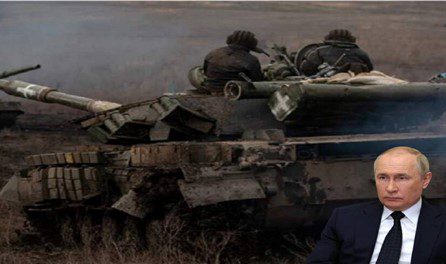
The war in Ukraine marks two years of full-scale military conflict. The current developments seem to no longer meet the expectations of the Ukrainians and the collective West, which stands behind them and strengthens them politically, economically and militarily. Amid much fanfare, Ukraine launched its summer offensive in early June 2023, which eventually fizzled out ingloriously in mid-autumn.
The Ukrainian counter-offensive was prepared, staffed by NATO, equipped and trained in NATO strategic and tactical doctrines. At least 14 Ukrainian brigades were trained in Europe (France, Germany, Holland, Britain, etc.). They were equipped with a large stockpile of tanks, armored vehicles, guns and ammunition generously supplied by the West.
The counterattack was intended to deal a substantial blow to the Russian army, which would change the war and liberate important territories. The objective was for Ukrainian forces to reach the coast of the Sea of Azov in the Mariupol region, splitting the Russian forces in two, thereby cutting off their only land link. At worst, Ukrainian generals expected to at least recapture the cities of Melitopol and Tokmak.
The disappointing results were compounded today by a series of negative events and the division of the country's leadership. We report the return of political strife in Ukraine, with Kyiv Mayor Vitaly Klitschko attacking President Zelensky and the stark contrast that has emerged between Zelensky and Chief of the General Staff Zaluzny. Now, Western aid is constantly decreasing, support fatigue is emerging and constantly expanding due to the duration of the war, resulting in disagreements between European states on EU policy, due to the poor economic situation as well.
Constant fluctuations
The last three months have seen the lowest foreign aid to Ukraine since the start of the war, due to the refusal of Congress to approve a new aid package before the end of the year. There are still voices and trends from many Western states pushing Kiev to open negotiations with Moscow as the stalemate on the front deepens. This is stubbornly denied by the Ukrainian president, who took care and legislated the prohibition of any contact and conversation with Russia.
Anyone who comes into contact with Russians is accused of high treason! Russia, meanwhile, has not only weathered the storm, but has taken the lead, with its forces launching a series of heavy-handed assaults on the fortress city of Advika in the Donbass, as well as elsewhere on the 1.500km front. All of the above paints a bleak picture of Ukraine and its future prospects.
But it is clear, from the monitoring of the war and the way it is covered by the international media, the perceptions of the developments are wrong, too deliberate and misleading. Examining the operations throughout this time, we arrive at the assessment – guided by military science and developments in the field – that there are different stages and periods. Each period ended differently, than what was calculated, reversing or refuting the predictions up until then. Both Ukraine and Russia are periodically seen as the inevitable winner of the conflict, until the assessments are disproved. Thus the war itself continues and the dramatic fluctuations on the battlefield have become less frequent.
The first estimates preceded the war itself. In the run up to the Russian invasion, Russian forces were expected to crush the Ukrainian troops, that Russia's far better equipped army would triumph in open battle on the undigested field. Russia was expected to use its huge advantage in long-range missiles in a "shock and awe" campaign that would decimate much of Ukraine's military.
Top US military officials, as well as the CIA, reportedly estimated that Russia could capture Kiev within 72 hours. Even many Ukrainian commanders had felt this way. Kirylo Budanov, Ukraine's director of military intelligence, told the New York Times in December 2021 that Ukraine had "nosufficient military resources to repel a full-scale attack by Russian forces» if he did not receive significant Western support in advance. "Believe me, without the surrender of [Western] reserves, there is no army in the world that can stand [against Russia]'. In the end, Ukraine held out. Russia's poorly planned and executed initial invasion failed, greatly delaying most of its objectives.
The regrouping of the Russians
So by early April 2022, Russian forces had completely withdrawn from northern Ukraine. However, President Putin, in a recent speech, revealed, even showing the document, that a peace agreement had been reached and the preliminary agreement had been signed in Istanbul in March 2022, between the two delegations. With it, the future of Ukraine was determined, with the forces it should have (with some differences between the two sides), that it would not join NATO, that a security framework would be created, that Crimea would remain Russian and Donbas would had a status of autonomy, as envisaged by the Minsk II Agreement.
The change in the attitude of the Ukrainian leadership, the violation of the agreement and the continuation of the war was due to the intervention of British Prime Minister Boris Johnson, who had gone to Kiev and had assured President Zelensky that the whole West would support him in every way and grant him western advanced weapon systems and ammunition.
Having withdrawn its brigades from northern Ukraine, Moscow focused entirely on the Donbas region. There it was able to deploy its huge advantage in artillery fire to overwhelm the Ukrainian army, as evidenced by its ability to annihilate the town of Popashna before capturing it on 7 May. With its massive Soviet-era military stockpile, the Russian military carried out relentless artillery attacks for months, another concept of warfare that gained popularity.
Russia was too big and too resilient to lose this war, its material advantages making any talk of a Ukrainian victory unlikely. Russia's progress could only be slowed, not stopped, and Western weapons in Ukraine will only prolong the inevitable, adding to the suffering. So the climate in the West and ΝΑΤΟ until late summer 2022 it was dark.
The Ukrainians in Kherson and Kharkiv
And suddenly the situation changes. In September 2022, Ukrainian forces launched a surprise attack on Russian positions east of the city of Kharkiv. Finding the Russian units undermanned and unprepared, the Ukrainians quickly broke through the Russian lines, which quickly retreated from their positions, with Ukrainian forces liberating almost the entire Russian-held district of Kharkiv within days, achieving a major victory .
Revelations about the state of the Russian military in the region, with some units operating at less than 30% of their intended strength, forced the Russian leadership to launch a chaotic partial mobilization just weeks later. The international media reported incredible situations in the Russian military, such as drunken Russian draftees brawling in their deployment zones. They even sparked protests against conscription, as well as a mass exodus of Russians.
This situation created the impression that Russia was on the verge of collapse, either on the battlefield or internally. The impression was reinforced by liberation of the city of Kherson (west of the Dnieper), without a battle, but with the withdrawal of the Russian troops (about 35.000 men) to the east side of the river, for security reasons, from the only Antonievsky bridge, which had remained intact.
Some analysts began talking about the end of the war by Christmas, and others talked about the possibility of the Ukrainian army finally reaching the Crimean peninsula within a few months. These significant successes of the Ukrainian army caused intoxicating and deifying reactions in the West, while Ukrainians believed that the situation would not be reversed. But that didn't last either. In fact, it was their last success in the land-based field of business.
Ioannis Ath. Baltzois is a lieutenant general, with M.Sc. in Geopolitical Analysis, Geostrategic Synthesis and Defense and International Law Studies, of the Kapodistrian University of Athens and president of the Hellenic Institute for Strategic Studies.