
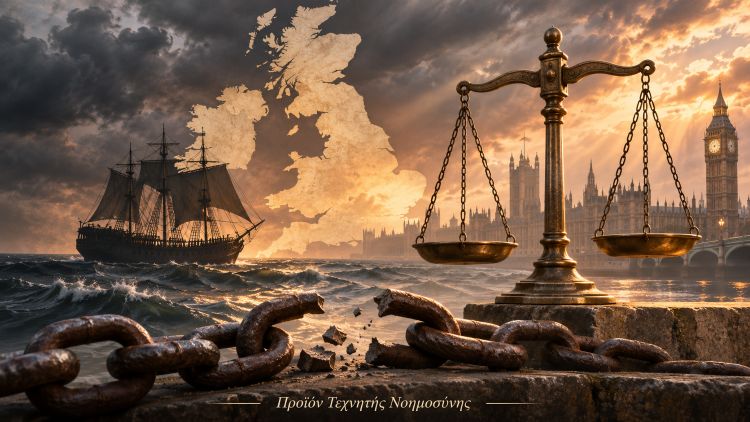
By Paul James — Uncensored
For Greek News & Radio FL
Slavery was one of the greatest atrocities in human history. However, if we are to discuss historical responsibility and reparations, we must surely be prepared to examine the whole story and not just the chapters that serve a particular argument.
There is a debate going on today about slavery, historical responsibility and whether the UK should pay reparations to the descendants of enslaved Africans.
This is a discussion that requires honesty, historical accuracy and, above all, justice.
I want to make my position clear from the outset. Slavery was horrific. It was cruel, inhumane and fundamentally wrong. Millions of people were deprived of their freedom, separated from their families, abused and forced to live in conditions of servitude. Nothing can justify what happened.
However, I do not support the view that the present-day United Kingdom should bear financial responsibility for past slavery simply because Britain was one of the countries involved in the transatlantic slave trade.
I also believe that there is a much broader historical picture, which needs to be recognized.
WORK WAS NOT A PHENOMENON EXCLUSIVE TO ONE RACE OR ONE COUNTRY
One of the problems with modern discussions of slavery is that the issue is often reduced to a single narrative: white Europeans enslaved black Africans.
This historical reality certainly has some basis, especially with regard to the vast transatlantic slave trade. However, it does not constitute the complete history of slavery.
Slavery has existed for thousands of years, across different continents, cultures, and societies.
African kingdoms, rulers, and traders were involved in the capture, trade, and sale of other Africans. Kingdoms such as Dahomey, Ashanti, and Kongo were involved in different aspects of this trade.
Some captives came from wars, raids, kidnappings and political conflicts, before being sold to European traders on the African coast.
This does not absolve Europeans of their responsibilities. It simply demonstrates that the history of slavery cannot be honestly presented as a crime in which only one group of people participated.
European merchants and governments created a vast international trading system, transported millions of Africans across the Atlantic, and fueled plantation economies in the Americas and the Caribbean.
This responsibility is real and should never be questioned.
BUT WHAT ABOUT THE PEOPLE WHO WERE ENSLAVED IN EUROPE?
This is another chapter in history that deserves greater recognition.
Britain itself has experienced invasions, conquests, occupation and enslavement.
In 43 AD, Roman forces invaded Britain under Emperor Claudius.
Roman rule lasted for almost four centuries. The Roman Empire maintained an extensive system of slavery, and there is archaeological and historical evidence to document the existence of enslavement in Roman Britain.
More than seven centuries later, the Vikings were raiding settlements across Britain and Ireland.
They captured men, women, and children and sold some of them as slaves through trade networks that stretched across Europe and beyond.
There is also a particularly interesting aspect of British history that deserves attention.
Bristol museum collections record that English traders were involved in the sale of enslaved people from Britain to Viking settlements in Ireland.
Some were prisoners of war, others had been kidnapped, while some were sold into slavery due to poverty.
In other words, the British were not simply descendants of a population that had always enjoyed its freedom.
There have also been victims, perpetrators, and participants in different historical systems of enslavement.
And the story doesn't stop there.
Between the 16th and 19th centuries, Barbary corsairs, operating from North African ports, captured European sailors and coastal residents.
Among those captured and sold into slavery were British men and women.
Professor Bernard Capp of the University of Warwick has documented the capture and enslavement of thousands of Britons in North Africa between 1580 and 1750.
These people had families, lives, and futures.
Many endured years of captivity. Some never returned to their homeland.
Why isn't their own story an equally important part of our national conversation about historical slavery?
BRITAIN WASN'T THE ONLY EMPIRE PARTICIPATING
Several European powers participated in the transatlantic slave trade.
Portugal, Spain, France, Britain, the Netherlands and other European interests participated in different ways.
African rulers and traders also supplied captives through organized trade networks.
Beyond the Atlantic, there were slave trade networks spanning the Sahara, the Red Sea, and the Indian Ocean, involving numerous African, Arab, North African, and other traders and political forces.
Slavery was a global problem, although its systems, extent, victims, and consequences varied considerably.
This raises a reasonable question.
If modern states are expected to assume financial responsibility for historical injustices, shouldn't this principle be applied consistently?
Shouldn't we also be discussing the historical responsibilities of every empire and power that invaded, conquered, enslaved, or exploited another population?
Shouldn't we be looking at the Roman occupation of Britain?
Shouldn't we be looking at the Viking raids and the enslavement of the Britons?
Shouldn't we also include the history of the Ottoman Empire and the enslavement of Europeans?
I am not arguing that modern Italy should automatically be held accountable for the actions of the Roman Empire or that Denmark and Norway should automatically compensate Britain for the Viking raids.
This would be an oversimplified approach to history.
But exactly the same caution should be exercised when discussing the responsibilities of modern Britain.
AND WHAT ABOUT THE COMPENSATIONS PAID TO THE SLAVE OWNERS?
There is a chapter of British history that cannot be ignored.
When the British Parliament passed the Slavery Abolition Act in 1833, the British government allocated 20 million pounds to compensate slave owners for the loss of what the law treated as their property.
The people who had been enslaved did not receive corresponding financial compensation.
The compensation was paid through public funds and state borrowing, while the relevant borrowing was not finally repaid until 2015.
This is an unpleasant aspect of our history.
Britain must acknowledge that its institutions and individuals profited from slavery.
The consequences of slavery and colonial exploitation also deserve serious historical examination.
However, recognizing historical injustices and accepting an unlimited financial obligation on the part of generations that were not responsible for them are two different issues.
WHY TARGET THE UNITED KINGDOM SPECIFICALLY?
I recognize that the Caribbean Community, known as CARICOM, has developed a ten-point plan for reparations.
This plan is not directed exclusively against Britain.
It calls on the UK, Europe and all states that participated in slavery to address the consequences of slavery, colonialism and exploitation.
This distinction matters.
However, I still question how financial compensation could be calculated and distributed fairly.
Who is entitled to compensation?
How many generations should be included?
How will individual eligibility be determined?
How will the distinction be made between the different historical forces involved?
How do we account for the African kingdoms and traders who sold captives, the European governments who financed the trade, the plantation owners who reaped the profits, and the wider international networks that sustained it?
And perhaps most importantly: how can we create a fair system of accountability without making ordinary people of today financially accountable simply because of their nationality or origin?
These are not unreasonable questions.
They deserve meaningful responses, rather than being dismissed as offensive.
HISTORY CANNOT BE CHANGED
I didn't live during the era of the transatlantic slave trade.
Nor do the vast majority of people living in Britain today.
I cannot accept personal guilt for something that happened many generations before my birth, just as I would not expect someone born today in another country to accept personal guilt for every historical atrocity committed by their ancestors.
We must teach history.
We have to keep it alive.
We must recognize the victims, name those responsible, and understand how the events of the past shaped the modern world.
But we cannot change history.
We cannot bring back to life those who have died.
We cannot undo the pain of families separated by slavery.
We cannot undo centuries of exploitation.
What we can do is ensure that future generations know the whole story.
And that means we have to tell it in its entirety.
Not only the history of European slavery in Africa, but also the history of African participation, the enslavement of Europeans, the Viking slave trade, the Roman conquests, the North African corsairs, the Ottoman expansion, and the many other systems that existed throughout the world.
No race has an exclusive right to historical pain, and no nation should be exempt from historical criticism.
MY POSITION IS ABOUT JUSTICE, NOT THE DENIAL OF HISTORY
Let me conclude by saying something that I hope is understood.
I do not deny Britain's participation in the transatlantic slave trade.
I am not defending slavery.
I do not underestimate the suffering of black communities nor the historical consequences of colonialism.
I simply disagree with the principle of demanding financial compensation from the UK without first establishing a consistent, evidence-based and truly international approach to historical responsibility.
Britain has a history of invasion, occupation, enslavement, exploitation and human suffering, just as it has a history of empire, trade, colonialism and the abolition of slavery.
We must be honest about every aspect of this story.
If we are going to discuss justice, let's discuss it for everyone.
If we are going to discuss historical responsibility, let's examine everyone involved.
And if we are going to talk about compensation, let's determine why it should be paid, to whom, what its amount will be, and based on what evidence.
I believe in preserving historical memory, not in falsifying history.
I believe in recognizing human suffering, not evaluating it on racial grounds.
And I believe that justice should be applied to everyone, not just those who happen to be at the center of today's political debate.
History is history.
We cannot change what happened, but we can decide what lessons we will learn from them.
Paul James
Author, columnist and commentator