Amid heightened international tension, Moscow has test-fired a nuclear-capable ballistic missile. The launch coincided with a major US nuclear readiness exercise. Global Thunder 27.
October 30, 2026 | International Security – Geopolitics
Russia has carried out a new demonstration of its strategic military capabilities, carrying out a test launch of a Bulava intercontinental ballistic missile from a nuclear-powered submarine of the Pacific Fleet.
The launch was announced on October 28, 2026 by the Russian Ministry of Defense, while also releasing video from the operation.
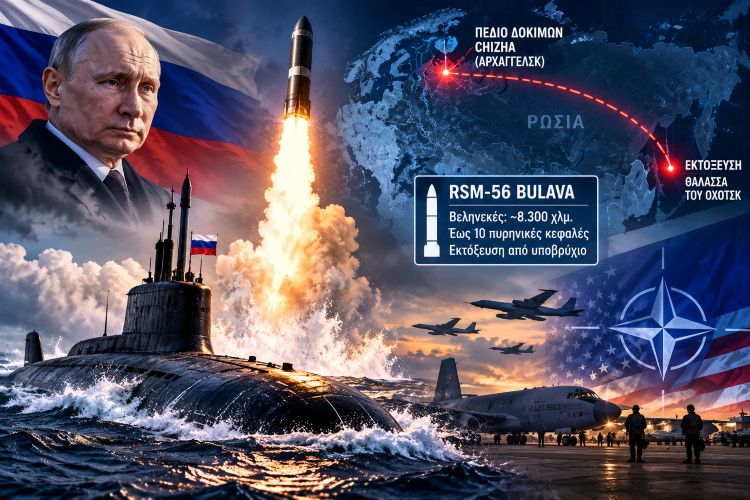
The missile was launched from the strategic submarine Generalissimus Suvorov (K-553), which was diving in the Sea of Okhotsk, in the Russian Far East.
The target was the Chizha test site, in northern Russia, in the Arkhangelsk region, near the Barents Sea.
According to the Russian announcement, the missile's parts simulating the warhead arrived at the designated area at the scheduled time.
Moscow called the test a success, but its result has not been independently confirmed.
A missile capable of carrying nuclear warheads
The RSM-56 Bulava, known to NATO as SS-N-32, is a key element of the maritime component of Russia's nuclear deterrent.
It is a solid-fuel ballistic missile, designed to be launched from submarines and hit targets at intercontinental distances.
According to data from the US Center for Strategic and International Studies (CSIS), Bulava has an estimated maximum range of approximately 8.300 kilometers and the ability to carry up to ten independently guided nuclear warheads.
The Borei-A-class submarine Generalissimus Suvorov can carry up to 16 Bulava missiles.
This does not mean that 16 missiles were launched during this particular test or that 16 nuclear warheads were used.
On October 28, a missile launch was announced. There is no evidence available to prove that it carried an actual nuclear payload.
From the Pacific to the Russian Arctic North
The geographical route of the test is of particular military interest.
Bulava was launched from the Sea of Okhotsk and headed west, crossing a long distance over Russian territory.
According to available estimates, the distance between the launch area and the test range was approximately 5.500 to 6.000 kilometers.
Choosing this particular route allows the Russian armed forces to test the operational capabilities of their strategic submarines.
At the same time, it is a demonstration of Moscow's ability to launch strategic weapons from different maritime areas.
The Generalissimus Suvorov joined the Russian Navy in December 2022 and was transferred to the Pacific Fleet in 2023.
The latest test was not its first with a Bulava missile. The same submarine had conducted a similar launch in November 2022, during its acceptance tests.
The timing of the US exercise Global Thunder 27
The Russian launch took place at a time when the United States is conducting major strategic exercises. Global Thunder 27.
The exercise began on October 22, 2026 and includes command, control, and readiness procedures for US nuclear forces.
Its aim is to assess the operational readiness and effectiveness of the American deterrence strategy.
As part of the exercise, American B-52 strategic bombers carried out activities in Northern Europe, with the participation of British and Norwegian fighter aircraft.
The timing of the two military activities is attracting the interest of analysts, especially given the strained relations between Russia and the West.
However, the US Strategic Command has clarified that Global Thunder is a planned annual exercise and is not carried out in response to the actions of any specific country.
There is no confirmed information that the Russian launch was a direct response to the American exercise.
Moscow's strategic message
Submarine-launched ballistic missiles are one of the most important means of nuclear deterrence.
A submarine's ability to remain hidden under the sea and launch strategic missiles offers a significant military advantage.
Even if a country is attacked on its land-based nuclear facilities, its submarines can, under certain conditions, retain the ability to strike back.
This is one of the main reasons why Russia, the United States, Britain and France are investing in maintaining and modernizing their strategic submarines.
The Bulava test can therefore be interpreted as a demonstration of military readiness and technological capabilities.
However, it does not in itself constitute evidence of preparation for an imminent nuclear attack.
A new period of strategic uncertainty
The launch takes place in an environment where the war in Ukraine, Moscow-NATO relations, and the debate over nuclear deterrence continue to affect international security.
Military exercises and strategic weapons tests take on particular political significance, as every move is monitored by opposing forces.
The most important question is not just whether a missile can travel thousands of kilometers.
It is whether the major nuclear powers can maintain reliable channels of communication and mechanisms to prevent a dangerous escalation.
The Bulava test Recalls that nuclear arsenals remain a determining factor in international relations. The real challenge for the international community remains to prevent the military show of force from turning into a real conflict.
sources
- Interfax – Russia, October 28, 2026
Report with the announcement of the Russian Ministry of Defense about the test launch.
- The Barents Observer – October 28, 2026
Analysis of the missile's path and the timing of the American military exercise.
- Center for Strategic and International Studies (CSIS)
Technical characteristics of the Bulava missile, range and nuclear warhead carrying capabilities.
- US European Command – October 27, 2026
Official American announcement on exercise Global Thunder 27.
- russian Strategic Nuclear Forces – October 28, 2026
Specialized analysis of the test and the history of previous Bulava launches.
VIDEO – THE REAL LAUNCH OF THE BULAVA
Video 1 – CCTV+ | October 28, 2026
Footage released by the Russian Ministry of Defense shows the submarine, the crew's preparations, and the launch.