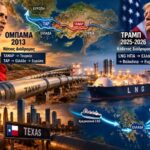
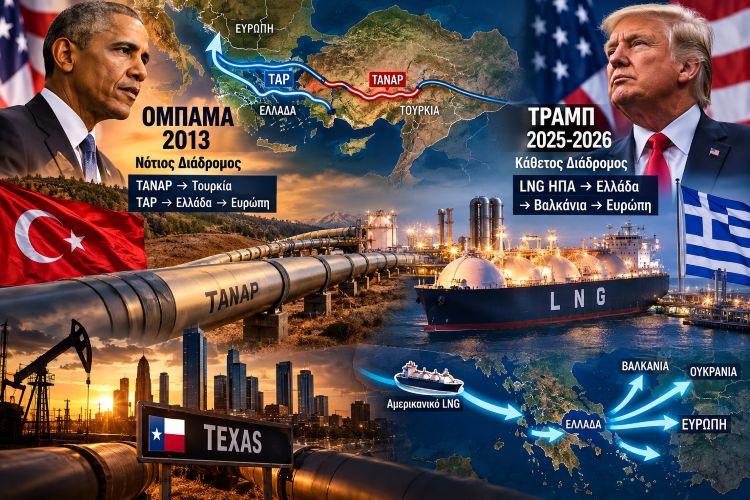
From the pipelines crossing Turkey to the Vertical Corridor starting in Greece. American energy strategy, Ankara's interests and Athens' new role.
Geopolitical Analysis – Energy Diplomacy
In international politics, gas pipelines do not just transport energy.
They transfer economic interests, create relationships of dependence, form alliances, and determine the strategic importance of entire countries.
To understand what is happening today between the United States, Turkey, and Greece, we must go back several years.
During the Barack Obama era, Washington actively supported an energy corridor that would transport natural gas from Azerbaijan to Europe via Turkey and Greece.
Today, under Donald Trump, the United States is promoting with particular intensity another energy route: the entry of American liquefied natural gas into Europe through Greek ports and its transportation to the Balkans and Ukraine.
What has changed? Why is Greece gaining increasing importance? And what position does Turkey hold on the new energy map?
The answers lie in the history of pipelines, supplier competition, and political decisions that followed the war in Ukraine.
The Obama Era: The Southern Corridor and Turkey's Role
In 2013, under the presidency of Barack Obama, the United States officially supported the selection of the Trans-Adriatic Pipeline (TAP) as part of the Southern Gas Corridor.
The plan envisaged the transport of Azerbaijani natural gas through Georgia, Turkey and Greece to the European market.
A central part of the plan was the TANAP pipeline, which crosses Turkey.
The gas then enters Greece through TAP, crosses Albania and ends up in Italy.
The choice served a specific American and European strategic goal: diversifying sources of natural gas supply and limiting dependence on Russia.
Turkey acquired an important role as a transit country, but Greece also formed an integral part of the same plan.
In fact, in November 2016, during Obama's visit to Athens, the White House officially reiterated US support for TAP and the Greece-Bulgaria interconnector.
Therefore, historically it cannot be argued that Obama exclusively supported Turkey at the expense of Greece.
What can be said is that the energy planning of the period recognized a pivotal geographical role in Turkey.
And Ankara has leveraged this position to enhance its importance in international energy relations.
TurkStream: When Turkey also cooperated with Russia
At the same time, Ankara was pursuing a parallel energy strategy.
In December 2014, Vladimir Putin announced the TurkStream project to Turkey.
Unlike TANAP, which transports Azerbaijani gas, TurkStream was designed to transport Russian gas through the Black Sea to Turkey and then to Europe.
The Russia-Turkey intergovernmental agreement was signed in October 2016.
The pipeline was inaugurated on January 8, 2020 by Putin and Erdogan.
The project has two parallel lines, with a total capacity of 31,5 billion cubic meters per year.
Here lies a significant geopolitical contradiction.
Turkey, a NATO member, was simultaneously participating in an energy corridor supported by the US and in a second one that served to transport Russian gas to Europe.
Ankara was thus strengthening its role as a transit country for different energy suppliers.
TurkStreamHowever, it was not Obama's work. It was a Russian-Turkish initiative and was met with reservations by Washington, especially during the first Trump administration.
This distinction is necessary to properly understand energy competition.
The Trump era: Greece as a gateway to American natural gas
The current energy strategy of the United States differs substantially from that of the previous decade.
The US now has a strong LNG export industry and is seeking to strengthen its presence in European markets.
Greece offers a significant geographical advantage.
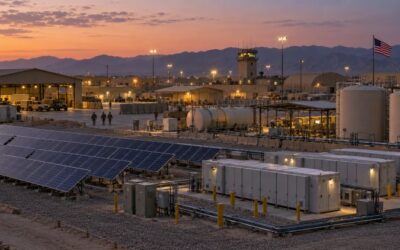
The Revithoussa and Alexandroupolis facilities allow the import of liquefied natural gas by ship and its distribution into the European pipeline network.
Through the Vertical Natural Gas Corridor, gas can be directed from Greece to Bulgaria, Romania, Moldova, Ukraine and other markets in Central and Eastern Europe.
On November 7, 2025, in Athens, the Energy Ministers of Greece, Bulgaria, Romania, Moldova, Ukraine, and the United States officially supported the development of this corridor.
In February 2026, the US Department of Energy hosted a new meeting in Washington to accelerate related projects.
The Trump administration's interest is clear: more export potential for American LNG and access to European markets looking for alternatives to Russian natural gas.
However, it should be clarified that the Vertical Corridor was not first created by Trump.
The initiative had already been in place since 2016, while in 2017 a relevant memorandum of cooperation was signed between the network managers of Greece, Bulgaria, Romania and Hungary.
The current US administration has strengthened political support for its development and commercial exploitation.
The difference is that today the Greek energy corridor is directly linked to the American LNG export strategy..
The two energy paths and the big question
Let us examine the geopolitical significance of this development.
The Southern Corridor, through TANAP and TAP, transports natural gas from Azerbaijan, passing through Turkey and Greece.
The Vertical Corridor seeks to transport natural gas from Greece to northern and eastern Europe, utilizing, among other things, LNG imports from the United States.
These are different but complementary networks, which can enhance the diversification of European energy supply.
Their strategic importance is not limited to transportation fees.
A country that has import ports, pipelines, storage facilities, and trade agreements gains greater participation in the energy decisions of the wider region.
This explains why Turkey seeks to maintain its role as a transit hub and why Greece is trying to strengthen its own position.
Control of energy routes does not equate to control of the states that use them. However, it creates economic influence and additional diplomatic tools.
An interesting detail: Trump also cooperates with Turkey on energy issues
Here the comparison becomes even more interesting.
On September 24, 2025, the Turkish state-owned company BOTAŞ announced a long-term agreement with Mercuria for the supply of American LNG.
The agreement covers the period 2026–2045 and concerns a total of approximately 70 billion cubic meters of natural gas, according to the Turkish announcement.
A few weeks later, on November 7, 2025, the first long-term Greek agreement to import American LNG was announced, with an initial contractual quantity of 700 million cubic meters per year from 2030.
The two contracts have a different structure and are not directly comparable in terms of their volume or financial value.
However, they demonstrate something important.
Washington is not limiting its energy relations to Greece. It is also seeking a commercial presence through Turkey.
Therefore, the current American strategy cannot be interpreted simply as replacing Turkey with Greece.
It is more about developing multiple energy routes, with an important common element being the strengthening of the American presence in the European market.
The war in Ukraine changed the balance
The Russian invasion of Ukraine in February 2022 was a turning point for European energy policy.
The European Union has accelerated its efforts to reduce its dependence on Russian gas.
In January 2026, the European regulation to phase out Russian natural gas imports was approved, with the aim of completing the process by 2027.
This decision creates new trade opportunities for alternative gas producing and importing countries.
The United States seeks to increase its exports.
Greece seeks to capitalize on its geographical location and infrastructure.
Turkey is trying to remain an important energy hub, while maintaining relationships with different suppliers.
European countries are also seeking greater security of supply, but this does not mean that the risks of high prices or new dependencies have been eliminated.
Competition is therefore not just about who has pipelines.
It concerns who produces the natural gas, who buys it, who transports it, and who secures the long-term commercial contracts.
Greece has a new opportunity. Will it seize it?
Greece's growing importance on the energy map constitutes a real economic and diplomatic opportunity.
However, the designation of a country as an energy hub does not automatically guarantee economic prosperity.
To turn the geographical location into a real benefit, competitive transportation fees, adequate infrastructure, contracts with buyers and investments that create value in the Greek economy are needed.
Equally important is to examine whether increasing energy imports and transit can benefit consumers and Greek industry.
It is not enough for natural gas to pass through Greek territory.
The Greek state and economy need to reap measurable and lasting benefits.
Conclusion: In the geopolitics of pipelines, changes have an explanation
Energy policy is not shaped by a president and does not stop when he leaves power.
It follows economic needs, strategic pursuits and changes in the international environment.
Barack Obama supported an energy corridor that would bring Azerbaijani natural gas to Europe via Turkey and Greece.
Donald Trump is today strengthening the strategy of transporting American LNG through Greece to the markets of Central and Eastern Europe, without abandoning energy cooperation with Turkey.
Turkey seeks to capitalize on its position between Asia and Europe.
Greece has significant advantages as a European energy import and transport gateway.
The United States seeks a commercial and strategic presence in European energy markets.
And Europe is seeking new balances after the major upheaval caused by the war in Ukraine.
Ultimately, the great geopolitical confrontation is not simply between two pipelines or two American presidents. It is the attempt to reshape the sources of supply and the routes of natural gas transportation to Europe.
And within this process, Greece and Turkey have acquired roles of particular strategic importance.
Because in the modern world, energy is not only an economic good. It is also a tool of power.\
Geopolitical Commentary: From Obama to Trump – In Energy, Nothing is Random
There is an interesting historical comparison worth considering.
Under President Barack Obama, the United States supported the Southern Gas Corridor, with the TANAP pipeline crossing Turkey and the TAP continuing through Greece to Europe. Turkey has thus strengthened its position as a major energy hub.
Today, under Donald Trump, the American energy strategy places particular emphasis on Greece, with the Vertical Corridor and the Alexandroupolis facilities offering new possibilities for transporting American natural gas to the European mainland.
What does this shift mean?
That energy routes are not determined only by geography, but also by economic interests, international alliances, and the strategic priorities of each era.
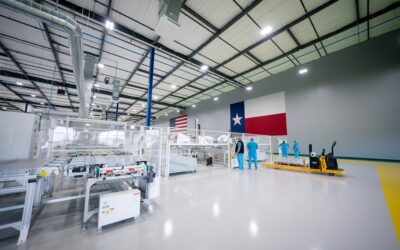
And here the big question arises: At a time when Washington is strengthening Greece's energy role, why are Turkish business groups expanding their investments in the heart of the American energy industry, in Texas?
There is no documented evidence that the two developments are part of a single plan. But there is one common element: energy creates interdependencies and economic interests that often transcend political confrontations.
In geopolitics, pipelines don't just carry gas. They carry interests, influence, and strategic power. And behind every major energy deal are decisions worth examining in depth.