
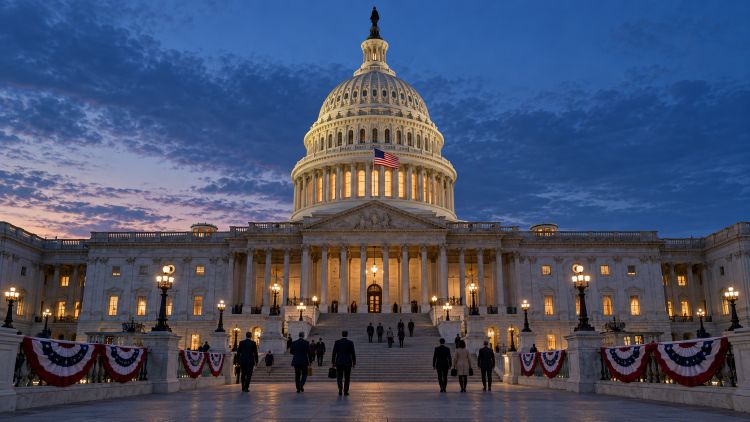
In a few days we will know whether Donald Trump will govern the next two years with a friendly Congress or with a Congress that will put the brakes on him at almost every step. Polls give the Democrats a clear lead in the House and a smaller one in the Senate. Nothing has been decided yet. But it is worth taking a cool look at what a Democratic victory would mean in practice, beyond the slogans of the campaign period.
The short answer is this: a Democratic Congress cannot govern in the President's place. But it can stop him, check him, and change the agenda in Washington. Let's take them one by one.
First, the limits of power
Before we talk about what Democrats can do, we need to say what they can't do.
The President has a veto. To override it, two-thirds of both houses are needed, a number that no forecast gives Democrats. The Senate also has a 60-vote threshold for most laws, so even with a majority, Democrats will need Republicans to pass anything serious. And Trump will always have executive orders and control of the ministries in his hands.
So if anyone expects that with a Democratic victory the tariffs will be lifted or the war with Iran will end overnight, they will be disappointed. The laws will be passed in Congress and will stop at the President's desk.
The biggest change: the power of research
Here lies the real change, and it will be evident in the first few weeks. The majority party controls the committees. It decides which hearings are held, what documents are requested, and to whom subpoenas are sent. While today Democrats can only send letters, with a majority they will be able to call witnesses by force of law.
House Democratic leader Hakeem Jeffries has promised that the investigations will begin “from day one.” The Judiciary Committee will be led by Jamie Raskin and the Oversight Committee by Robert Garcia. On the table are the Trump family businesses, cryptocurrencies, the businesses of his son-in-law Jared Kasner and foreign money. According to Reuters, the strategy is to start with hearings and document requests, not with an indictment.
This has happened before. Former White House counsel say that when subpoenas start coming in, they come in one after another, and managing them can consume an entire government. For the reader, this means something simple: over the next two years, we will hear a lot about hearings, documents, and disputes between Congress and the White House.
The question of the indictment
Trump himself has told his congressmen that if they lose the election “they will find a reason to impeach me.” Republicans are using this prospect to mobilize their voters.
The picture on the Democratic side is more complex. Jeffries says they have neither decided nor ruled out anything. Several close leadership aides warn that a new indictment could turn against them, as it did on the two previous occasions when Trump was impeached and acquitted by the Senate.
Here, too, the arithmetic counts. The House can impeach a President by a simple majority, but to remove him from office requires 67 senators. Even in the best-case scenario for the Democrats, they would be far short of the votes. Impeachment can therefore be politically motivated, removal is almost impossible.
The "100-day" agenda
House Democrats already have a plan in place for the first 100 days. Jeffries says the caucus will be united from the start on four points:
- reinstating Obamacare tax cuts,
- reversing cuts to Medicaid,
- votes against war with Iran,
- abolishing Trump's tariff system.
They have also set up five working groups on housing, health, childcare, food, fuel and bills. The message is clear: cost of living.
The reality is that many of these will pass the House and end up in the Senate or vetoed. What Democrats will gain are votes on the record, forcing every Republican to take a public stand on tariffs and war, just before the 2028 presidential election.
The state's wallet and the risk of shutdown
Here lies perhaps the most immediate practical issue. The federal government is currently funded only until December 11, with a temporary extension. If Democrats win, they will likely push for a new temporary solution so that the budget can be closed when they have the majority, in January. Republicans, on the other hand, will want to close the budget while they still control both houses, during the December transition period. The debt ceiling will also be on the table, which could become an issue again as early as 2027.
History is not reassuring. In 2018, when Democrats won the House in Trump's first term, the new Congress began with a shutdown that lasted 35 days, a record for the time. Last year we had an even longer one, 43 days. For us in everyday life, this translates into delays in federal services, passports, visas, airports and civil servant payments.
Senate: the battle of appointments
If Democrats take the Senate, the change will be most visible in appointments. Every secretary of state, ambassador, and federal judge must be confirmed by the Senate. Democratic leader Chuck Schumer told Semafor that if the nominees are anything like the current ones, “very few” will be approved. He also suggested that if a Supreme Court seat opens up, Democrats might keep it vacant until the next presidential election, as Republican Mitch McConnell did with Merrick Garland in 2016.
Republicans say this is pure obstruction. Senator John Barrasso has said that a Democratic Senate would block any Trump nominee. In practice, the President has one escape route for departments: he can appoint acting deputies who do not require approval. But there is no such escape route for judges. This is perhaps the most long-term effect of this election, because federal judges are appointed for life.
And if they only take the Parliament?
It's a perfectly realistic scenario, and one that we experienced in 2018. With only the House, Democrats have the investigations, a piece of the budget, and the ability to impeach. But appointments will continue to pass with the support of the Republican Senate, and any bills the House passes will end up in the drawer.
The internal cracks
Both parties will have internal issues. The Democrats are entering a new generation of lawmakers, including members of the Democratic Socialists of America, who will push for a tougher line. Whether Schumer will have the support of the new senators to remain leader is not a given. For Republicans, a defeat would bring responsibility. Some lawmakers are already saying they would blame the President, and Mike Johnson's position as leader of the parliamentary group is not considered secure.
What the two sides say
For Democrats, a Congress in their hands is a return to the control provided by the Constitution: a counterweight to a President who, they say, has acted without any oversight for the past two years. For Republicans, it is a recipe for paralysis: partisan investigations, blocking the agenda that voters voted for in 2024, and a party that they say has turned too far left.
What seems certain, whatever the outcome, is that the last two years of the Trump presidency will also be the campaign period for 2028. Every vote, every hearing, and every veto will be done with an eye on the next ballot box. We will be watching closely.
My own view
Living here in Florida, I've seen Washington change hands several times. What I've learned is not to take either the fears or the promises of the campaign season at face value.
A President from one party and a Congress from another is not something extraordinary in America. Reagan, Clinton, Obama and Trump himself experienced it in his first term. The system is designed so that one branch of government checks the other. Sometimes this brings compromises and sometimes deadlock.
I won't tell you which party is right. That's up to each person to decide based on what they expect from the government. But I will tell you what I'll be looking at in the coming months. Whether the two sides can agree on the basics, like the budget, so that we don't end up with closed services again. Whether the investigations will remain facts or become spectacle. And whether any of this will end up in our wallets: in prices, in insurance premiums, in the cost of living here in South Florida.
For the Greek diaspora, the practical side matters more than the theatrical. A shutdown means delays in passports and visas for relatives who want to come. A change in tariffs affects the prices of products we bring from Greece and Europe. We will monitor these and keep you informed, no matter what the ballot box brings.
Πηγές
- AP / PBS: House Democrats' 100-day agenda
- CS Monitor: Democrats plan investigations, affordability efforts
- Yahoo: Jeffries vows day-one investigations
- Katie Couric Media: Will they impeach Trump again?
- Semafor: Democratic Senate would confirm very few nominees
- Florida Phoenix / States Newsroom: Schumer on Supreme Court nominees
- Fox News: Congress dodged a fall shutdown, but the real fight looms
- Washington Examiner: Lame-duck to-do list
- NBC News: Republicans see impeachment threat as key midterm issue
- NPR: Democrats promise investigations if they win the House